Epson HX-20
Epson shipped the HX-20, a battery-powered portable with dual 6301 CPUs, built-in dot matrix printer, and microcassette storage, in 1982 as one of the earliest true notebooks, weighing four pounds and selling for approximately $800.
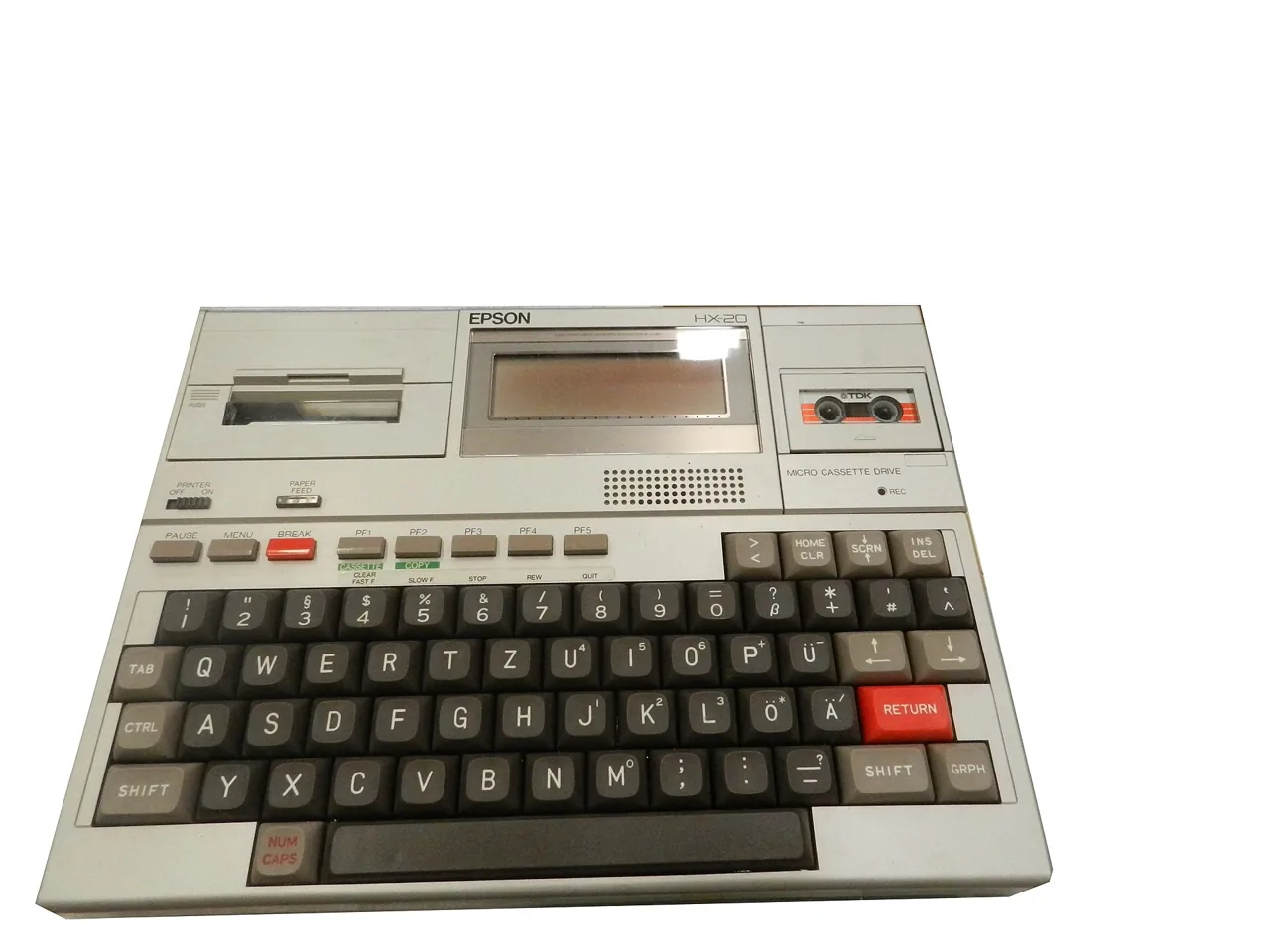
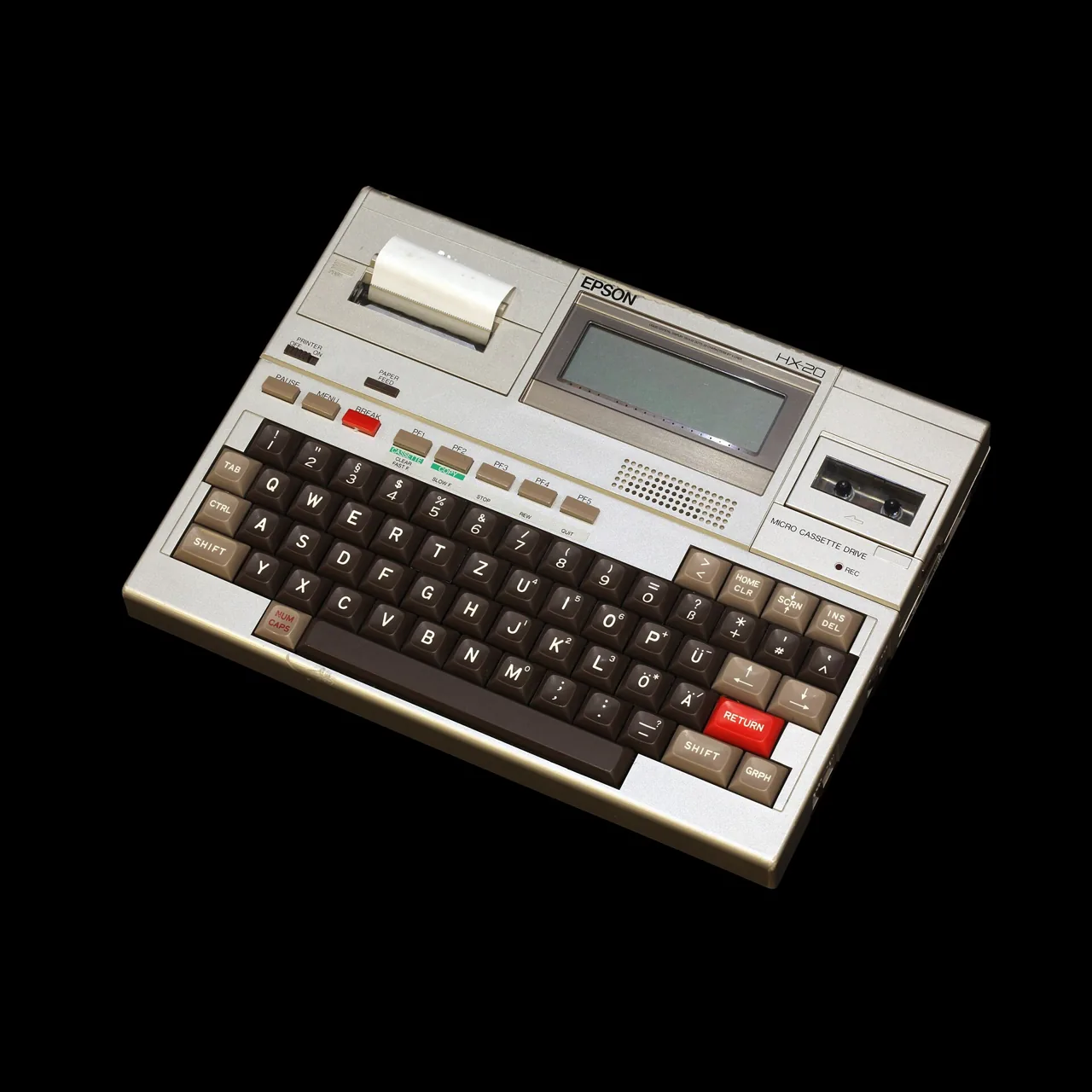
The HX-20 emerged from a two-year development cycle led by a ten-engineer team at Shinshu Seiki, the company that rebranded as Epson Corporation the same year the machine launched416. Marketed as a "Hand-Held-Computer" and later a "notebook computer," it integrated components rarely seen together in a portable: a full-size 68-key keyboard, liquid crystal display with four lines of 20 characters, and a built-in dot matrix printer capable of 42 lines per minute on 58 mm plain paper1212. The printer, positioned in the upper left of the chassis, supported both text and point-by-point graphics at a resolution of 120 dots per line12.
Processing was handled by two Epson-made 6301 CMOS 8-bit microprocessors, each upward compatible with the Motorola 6800 architecture and capable of addressing up to 104 KB of memory12. The system shipped with 8 KB of CMOS RAM and 32 KB of CMOS ROM, expandable to 16 KB and 40 KB respectively, for a total of 48 KB of combined memory212. This memory configuration allowed the unit to retain data without power, a critical feature for a portable device relying on nickel-cadmium batteries for up to 50 hours of operation112. A power adapter was also supported1.
Storage relied on a built-in microcassette system, supplemented by a standard cassette interface and cartridge interface for expansion3416. For higher-capacity needs, Epson offered an external dual floppy disk unit supporting double-sided, double-density disks with 320 KB per diskette1. The system bus allowed further expansion of RAM and ROM, and RS-232C serial interfaces enabled communication at speeds from 110 to 4800 bits per second123. An optional CX-20 acoustic coupler, operating above 300 baud, permitted terminal-style communication over telephone lines1.
Software was tightly controlled: the HX-20 ran a proprietary operating system developed jointly by Epson and Microsoft, and accepted no other market-available operating systems1. Programming was restricted to a Microsoft-developed BASIC variant stored in ROM, officially termed Epson-Microsoft BASIC12. Epson provided applications for word processing and spreadsheets, while third parties like Baehr Computer-Systeme distributed tools such as CTEXT and CFORM, sold for 398 and 169 Deutsche Mark respectively111.
Despite its compact form, described as no larger than a full-size keyboard, the HX-20 drew comparisons to the Radio Shack Model 100 and NEC PC-8201, both of which featured larger six-line by 40-character displays47. The HX-20’s four-line screen was a clear limitation, but its integrated printer and cassette system were unique among contemporaries4. BYTE magazine noted its advantages over desktops: no power cord, four-pound weight, and significantly lower cost, approximately $800, though some sources cite "about $800"7891012.
Third-party expansion included the Colour Display Controller by Oval Automation, a PAL-compatible unit that connected to the HX-20 and offered a 32-column by 16-line display, monochrome graphics on a 128 × 96 pixel matrix, or four-color graphics on 128 × 64 pixels13. It could drive an EPSON TF-20 floppy disk drive and displayed up to 512 alphanumeric characters or over 8,000 color pixels13. The device was fully compatible with HX-20 display commands, enabling enhanced output without software modification13.
The machine was sold in the United States as the Epson HX-207. Documentation, however, proved problematic: a German publication noted Epson failed to resolve documentation issues even in the second edition of the instruction manual, calling it a "troublesome problem"5. The HX-20 established a design language for portables (self-contained, battery-powered, and functionally complete) that would define the category4.
| Manufacturer | Epson (Shinshu Seiki) |
| Model | HX-20 (HX-20 in U.S.) |
| Announced | 1982 |
| CPU | Dual 8-bit Epson 6301 (6800 compatible) |
| Memory | 8 KB RAM (expandable to 16 KB), 32 KB ROM (expandable to 40 KB) |
| Display | 4 lines × 20 characters LCD |
| Printer | Built-in dot matrix, 24 columns, 42 lines/minute, 120 dots/line |
| Storage | Built-in microcassette; optional dual 320 KB floppy unit |
| I/O | RS-232C (110–4800 bps), system bus, cartridge interface |
| Power | NiCd batteries (50+ hours), power adapter |
| Weight | Approximately 4 pounds |
| Operating System | Proprietary Epson/Microsoft system |
| Programming | Epson-Microsoft BASIC |
References
- enciclopedia pratica de informatica vol 3
- EpsonHX20-Handheld-GE
- 1982 12 BYTE 07-12 Game Plan 1982 (1982)
- Epson QX-10 Users Guide JamesHansen(bad copy)
- ComputerPersoenlich 83 19
- 1983 04 BYTE 08-04 New Chips (1983)
- MICRO Vol62-07 83
- micro 61 jun 1983[ocr] (1983)
- MICRO Vol61-06 83
- ComputerPersoenlich 83 13
- 1983 03 BYTE 08-03 Mass Storage (1983)
- EpsonColorDisplay ControllerForHX20
- ComputerPersoenlich 82 23
- Epson QX-10 Users Guide JamesHansen(bad copy2)