Heathkit H8
The Heathkit H8, introduced in 1977 by the Heath Company, was a build-it-yourself microcomputer kit based on the Intel 8080 architecture, notable for its intelligent front panel and expansion ecosystem that supported both HDOS and CP/M operating environments.
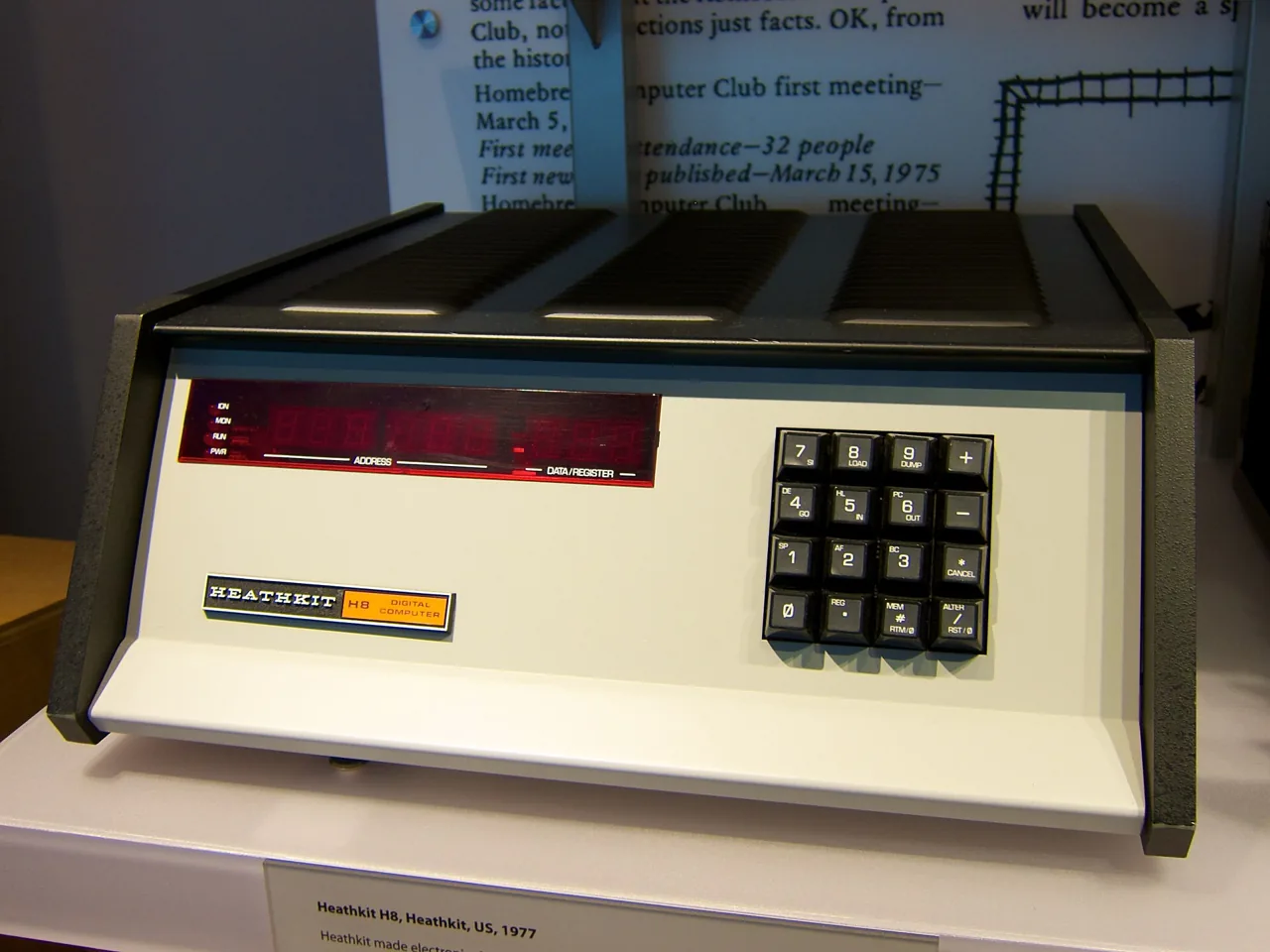
Assembly was the entry point: the H8 shipped as a kit requiring user construction, a hallmark of Heathkit’s pedagogical approach to electronics4. The machine centered on a processor board mounted in a steel chassis, with a front panel featuring a nine-digit display and keypad that enabled direct memory manipulation and one-button program loading, an interface described in contemporary documentation as “innovative, user oriented”413. This subsystem departed from the S-100 bus conventions dominant in early microcomputers, opting instead for a proprietary backplane design with seven plug-in board positions267. A 10-position motherboard accommodated the core logic, though expansion beyond factory limits was achievable; the STRETCH-8 add-on provided eight additional slots, yielding 15 available for memory, I/O, and special-purpose cards8.
Base specifications were minimal: 4K of RAM and a cassette-based operating system formed the starting configuration9. No ROM size is documented for the original H8, and the CPU clock speed remains unspecified in primary sources. Later upgrades like the Z-H8 board introduced programmable clock rates selectable between 2 MHz and 4 MHz under software control, with configurable wait states5. The C-H8 adapter kit, released later, included an 8085 microprocessor running at 5 MHz, 8K of on-board RAM, 8K of ROM, and full HDOS and CP/M software suites included in the price1. That kit also featured full DMA operation via an Intel 8219 bus controller and used 55 integrated circuits1.
Storage evolved from cassette tapes to floppy disks through available peripherals. The H17 2350 hard-sector floppy disk controller was a common upgrade, paired with an H17 drive and power supply115. A Western Digital 2793 controller chip managed disk operations, and a double-density controller supported both 8-inch and 5.25-inch formats114. The controller supported hard-sectored disk formats14.
Software support was unusually comprehensive for a kit machine. The base package included Microsoft BASIC, an assembler, editor, and debug software: tools competitors often sold separately for over $6011. FORTRAN and wordprocessing applications were also available27. Two operating systems were supported: HDOS, Heathkit’s proprietary disk operating system, and CP/M, the emerging standard for 8080-based systems15. Firmware packages for both were bundled with the C-H8 adapter1.
Peripherals expanded the H8 into a full workstation. The H9 12-inch CRT terminal, equipped with an ASCII 67-key keyboard, was the primary display interface1310. Interface boards enabled parallel (H-8-2), serial (H-8-5), and 4-port serial (WH-8-41) connectivity15. Specialized add-ons included a music board and a color graphics board (HA-8-3), though technical details such as resolution or sound capabilities are absent from surviving documentation315. The Z-H8 board, a Z80-based CPU upgrade, allowed the system to run at 4 MHz with a transistor power supply and included bus termination and ORG ZERO configuration circuits5.
User support was institutionalized through the Heath User’s Group (HUG), which hosted national conferences and published software and technical notes671015. Heathkit Electronic Centers and a nationwide service network provided repair and training, including a continuing education course in 8080/8085 assembly language programming (course EC-1108)101316. The company maintained its reputation for reliability, citing “backed by 54 years of Heath reliability,” to position the H8 as a serious tool, not a hobbyist toy11.
The H8’s legacy lies in its bridge-building: it offered a structured, documented path from kit assembly to professional computing. While its original $375 mail-order price (FOB Benton Harbor) placed it within reach of enthusiasts, the ecosystem encouraged incremental investment11. Conflicting pricing references in the documentation suggest variable bundling strategies, but the core value proposition remained: superior documentation, expandability, and support11. It proved “extremely successful,” according to internal accounts9. The machine’s design reflected a belief that users should understand their tools, a philosophy embedded in every wire-wrap socket and front-panel button.
References
- remark-volume5-issue11-1984 (1984)
- 1979 10 BYTE 04-10 Genealogy (1979)
- remark-issue22-1981 (1981)
- 1979 03 BYTE 04-03 Plain Text (1979)
- remark-issue36-1983 (1983)
- 1980 01 BYTE 05-01 Domesticated Computers (1980)
- 1979 12 BYTE 04-12 Numerical Analysis (1979)
- remark-issue11-1980 (1980)
- MAKE Magazine OH 04
- remark-issue2-1978 (1978)
- 1978 07 BYTE 03-07 How To Get Your Tarbell Going (1978)
- 1978 05 BYTE 03-05 Graphics in Depth (1978)
- 1978 01 BYTE 03-01 The Brains of Men and Machines (1978)
- remark-volume5-issue2-1984 (1984)
- remark-issue42-1983 (1983)
- remark-issue6-1979 (1979)