Sinclair QL
Sinclair Research launched the QL in 1984 as a business-oriented personal computer powered by a Motorola 68008 processor and running the QDOS operating system, bundled with Psion-developed office software and equipped with two internal Microdrives for storage.
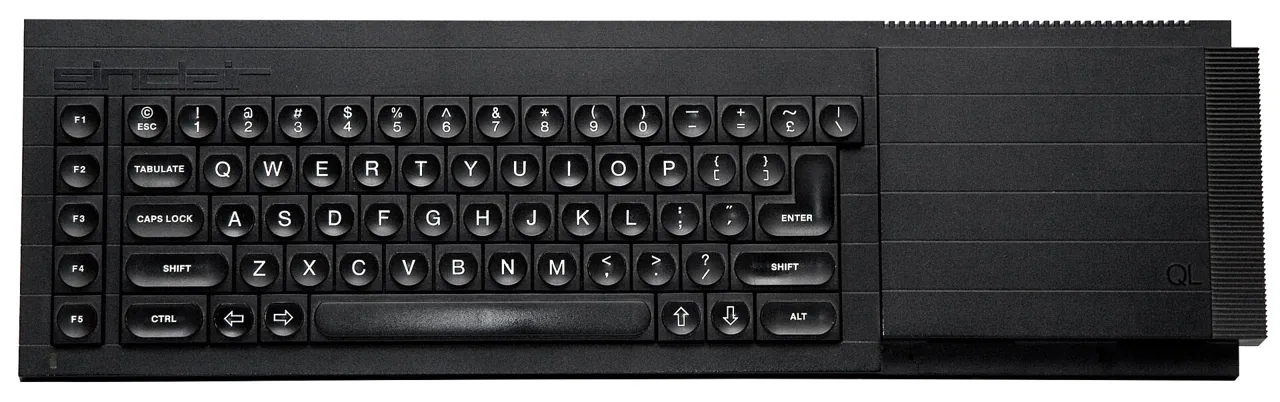
Unveiled in Munich on February 14 to a specialized audience, the Sinclair QL was positioned as a machine for "the discerning private user, schools, and smaller businesses" 6, marking a deliberate pivot from the company's earlier Spectrum line toward professional applications 13. Its architecture centered on the Motorola 68008, advertised as a "32-bit high-performance architecture" despite the wider market reliance on 8- or 16-bit systems at the time 611. With 128K of onboard RAM (standard, expandable to 640K via an external RAM pack) 61114, the QL offered a significant memory footprint for its class, though exact clock speed and bus widths remain undocumented in surviving materials.
Storage relied entirely on two built-in Microdrives, each cartridge holding 100K, a continuation of Sinclair’s cost-saving magnetic tape-loop design first seen in the Spectrum+ 61113. These drives drew immediate skepticism: software distribution on Microdrive was inherently slow and difficult to mass-produce compared to cassette tapes, and reliability concerns were openly acknowledged in contemporary reports 7. All software, including the operating system, had to be delivered on Microdrive, creating a bottleneck for developers and users alike 7. The bundled suite (comprising word processor, spreadsheet, database, and graphics applications) was developed by Psion, lending early credibility, but the fragility of the delivery medium undermined broad adoption 614.
The QL shipped with QDOS, the operating system of the QL, and SuperBASIC 714. However, QDOS was reportedly still under active modification as late as 1985, with developers warned that system routines could vanish or change between versions 7. This instability discouraged third-party investment, particularly from firms that had supported the Spectrum ecosystem, many of whom questioned the QL’s long-term viability 7.
Peripherals included two RS232C serial ports for printer and modem connectivity, mouse interface headers, and support for network communication, features aimed squarely at office integration 611. Optional add-ons included the Sinclair QL Complete Communications Pack with a V21/V23 auto-answer modem, though pricing was listed as "P.O.A." 12, and GST Computer Systems offered a professional development toolkit including a full-screen editor and 68000-compatible assembler for 199 Dutch guilders 2. Psion released QL Chess for 99 guilders 2. A technical guide covering QDOS, SuperBASIC, and machine code programming was made available separately for 15.90 guilders 7.
Priced at launch in Dutch guilders at ƒ999,- 11, the UK launch price is not explicitly documented, though by Christmas 1985 the machine sold for £199, stated to be half the original launch price, implying a starting cost of £398 8. This aggressive discount temporarily boosted sales but failed to stabilize Sinclair Research’s finances 8. By April 1986, Amstrad acquired the company, and Alan Sugar promptly terminated any plans for a successor model 8. The QL’s discontinuation was thus not a market decision but a corporate one, cutting short further development despite ongoing firmware revisions and niche professional interest.
The Microvitec Sinclair QL monitor, sold separately, carried a price tag of £270.00, nearly matching the discounted computer itself 10. This pricing structure highlighted the QL’s positioning as a complete system rather than a hobbyist kit, though the total cost of ownership remained substantial even after the price cut. The keyboard, featuring 65 full-travel keys with dedicated cursor controls, five function keys, and dual shift keys, was described as "full size, ergonomically designed" 14, a rare ergonomic consideration in Sinclair’s typically minimalist hardware philosophy.
Despite its technical ambition and professional targeting, the QL inherited the Microdrive’s limitations and suffered from an unstable OS and uncertain corporate backing. Its legacy rests not in commercial success (sales figures are unrecorded) but in its audacious attempt to reposition Sinclair as a serious player in business computing, an effort curtailed as abruptly as it began.
References
- Archive item #SG198509
- Archive item #SG198505
- Archive item #SG198506
- Archive item #SG198402
- Archive item #SG198502
- HomeComputer 8403
- Archive item #SG19850708
- Computers that made Britain v1
- Archive item #SG198510
- MICRO USER 030
- Archive item #SG198512
- AcornUser037-Aug85
- The Home Computer Course 06
- NZ-bits-and-bytes-issue-4-01