Sinclair ZX81
Sinclair Research Ltd. released the ZX81 in March 1981 as a £69.95 personal computer that expanded on the ZX80’s foundation with an 8K BASIC ROM and cassette program storage, selling over 50,000 units in its first three months.
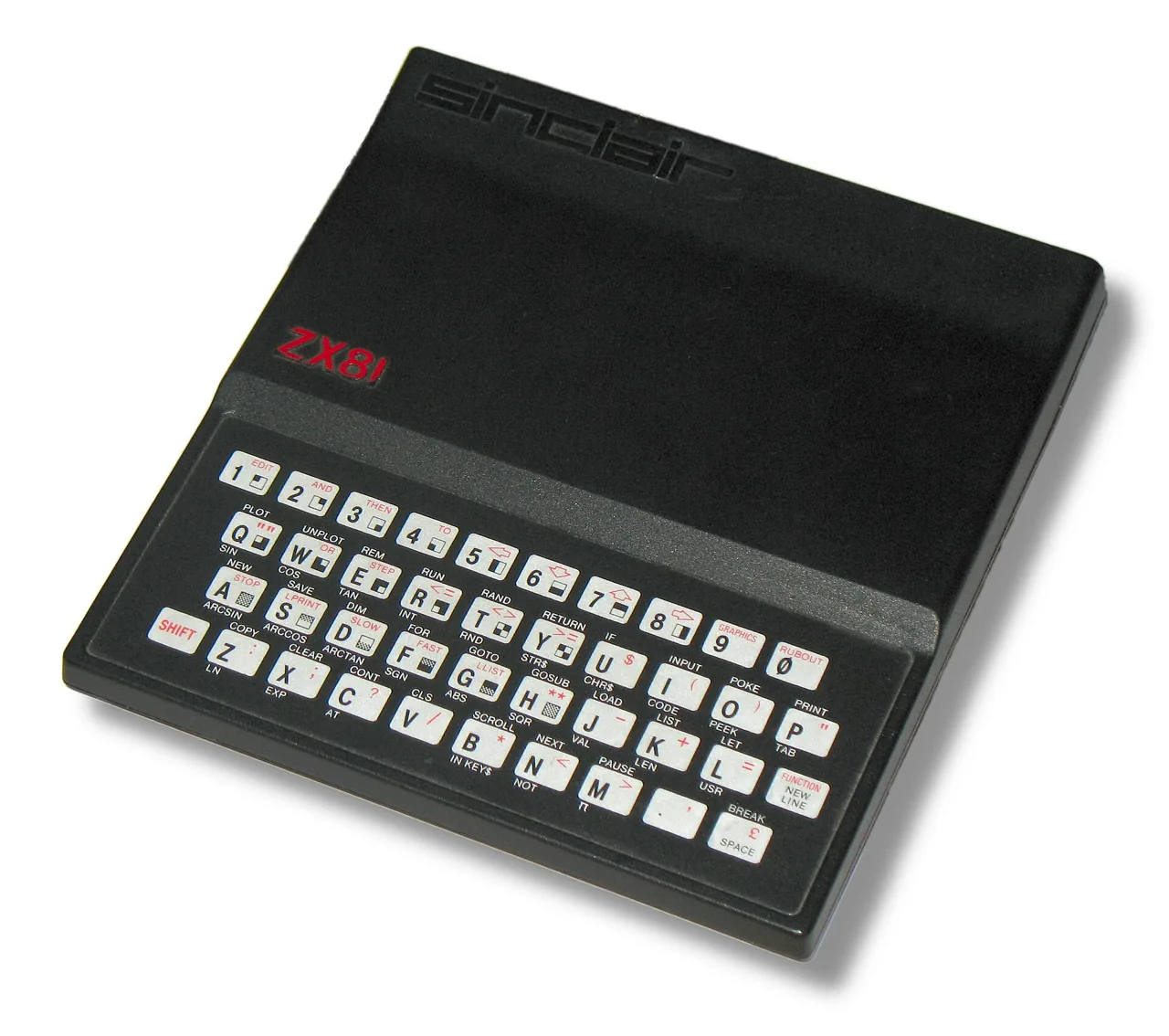
The ZX81 entered the market as a direct successor to the ZX80, which had achieved a milestone as the first complete personal computer under £100 and sold over 50,000 units36121315. At £69.95, the ZX81 undercut its predecessor while adding capabilities that justified the shift: a new 8K BASIC ROM described in period literature as the machine’s “trained intelligence”6121315. This ROM introduced decimal arithmetic, logarithmic and trigonometric functions, graph plotting, and animated display generation, features absent in the ZX80’s firmware6121315. ZX80 owners could upgrade via a drop-in replacement chip that included a new keyboard template and operating manual, granting access to all ZX81 features except animated graphics and printer support414.
Despite its minimal base configuration of 1K memory16, the ZX81 was explicitly designed for expansion. Sinclair’s 16K memory module plugged directly into the rear of the unit, increasing available memory sixteenfold5789106121315. The same rear port accommodated the Sinclair ZX Printer, which offered full alphanumerics, sophisticated graphics, and a dedicated COPY function to print the entire TV screen without additional programming11. The printer was advertised as forthcoming and priced under $1005710. The 16K memory module was priced at £29.95 in the UK11, though US pricing showed discrepancies across sources: $99.95 in Interface Age510 versus $49.95 in BYTE89.
The machine was sold both as a preassembled unit and as a kit, with the latter appealing to hobbyists seeking lower entry cost. US kit pricing was listed at $99.95510, though another source claimed $79.9589; similarly, the assembled US price was cited as both $149.95510 and $99.9589. All versions included the ZX81 BASIC manual and a mains adaptor34, and buyers received a 164-page programming guide valued at $10.9557. Sinclair also offered pre-recorded software on cassette, including titles such as Invasion from Jupiter, Skittles, Magic Square, and Rings around Saturn11, with the “ZX81 Learning Lab” package bundling a 160-page manual and eight cassettes, six with 20 instructional programs and two blank for practice414.
By August 1982, the ZX81 faced obsolescence. One contemporary account declared, “Like it or not, the ZX81 is on the way out,” citing its silent, black-and-white output and questionable reliability, particularly in LOAD and SAVE operations16. The Sinclair Timex 1000, its American counterpart, was noted to sell at approximately £49.9516. Despite this, a Sinclair representative maintained the machine still represented “the ideal introduction to computing,” emphasizing its role as “the heart of a system that grows with you”1636121315. Its successor, the ZX Spectrum, offered 16K of built-in memory, color, sound, and improved program storage for £125, rendering the ZX81’s limitations stark16.
References
- ZX81 BASIC Book
- ZX81 BASIC book(1982 Reprinted)(acme) (1982)
- ComputingToday198205 (1982)
- ComputingToday198204 (1982)
- Interface Age-1982-05 (1982)
- ComputingToday198205 (1982)
- BYTE Vol 07-05 1982-05 Japanese Computers (1982)
- 1982 08 BYTE 07-08 Logo (1982)
- 1982 09 BYTE 07-09 Computers and the Disabled (1982)
- Interface Age-1982-06 (1982)
- ComputingToday198209 (1982)
- ComputingToday198202 (1982)
- ComputingToday198207 (1982)
- ComputingToday198204 (1982)
- ComputingToday198206 (1982)
- Personal Computing Today Aug 1982 (1982)