Sinclair ZX Spectrum 48K
Sinclair Research Ltd released the ZX Spectrum 48K in 1982 as a colour-capable personal computer with 48K of RAM and an enhanced version of Sinclair BASIC, positioning it as a major advance in personal computing technology
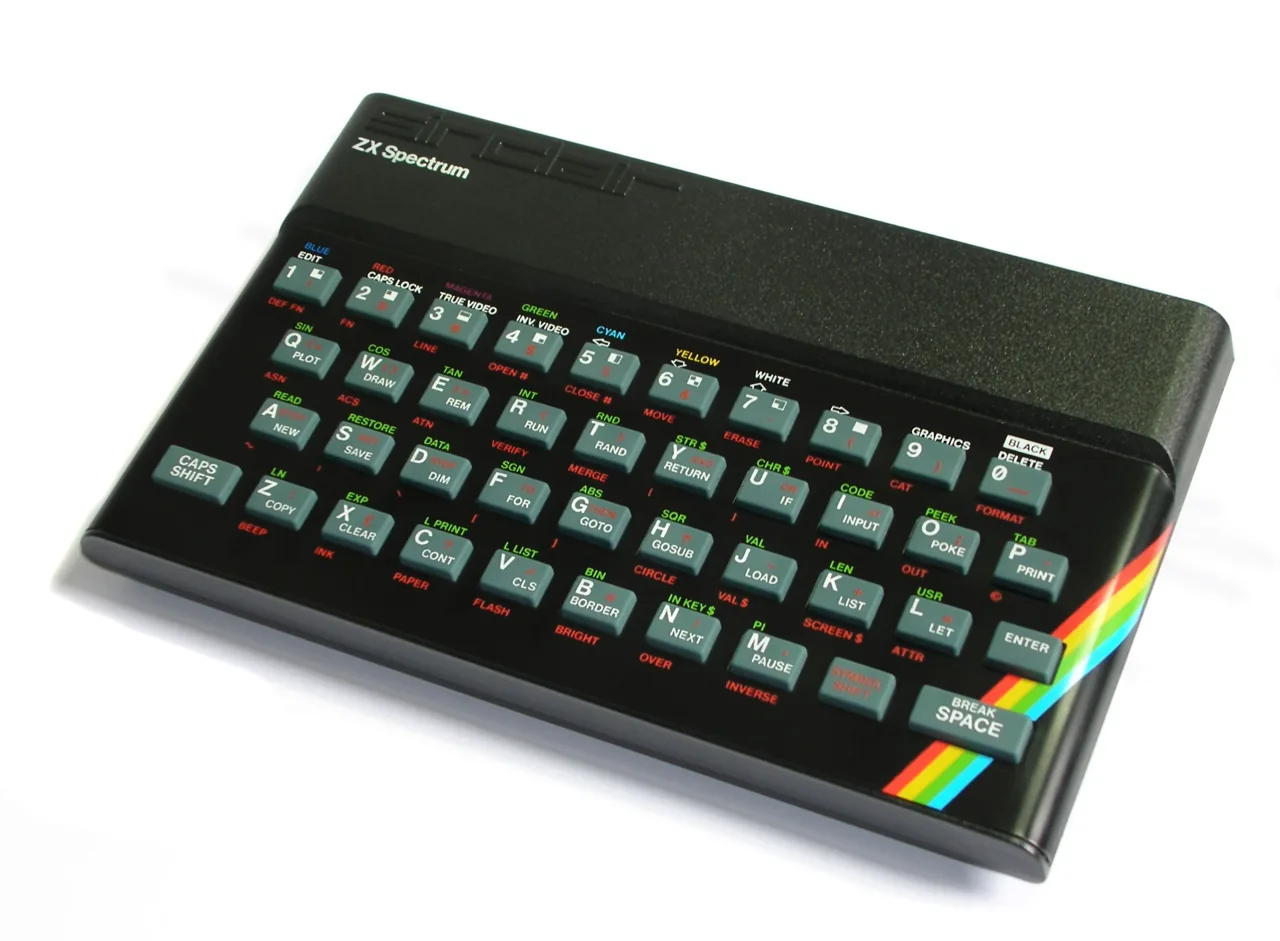
The ZX Spectrum 48K emerged directly from Sinclair’s strategy of iterative refinement, incorporating all the proven features of the ZX81 while introducing high-resolution colour graphics and a full typewriter-compatible 40 moving-key ASCII keyboard210. Clive Sinclair unveiled the machine in 1982, announcing it alongside the continued production of the ZX81, which had already achieved over 500,000 sales101415. The 48K model was one of two versions introduced, the other being a 16K variant priced at £125.00 inclusive of VAT25891013. A discrepancy exists in the record regarding the 16K model’s price, with one source listing it as £99.954, but the higher figure is corroborated by multiple contemporaneous publications.
The machine was built around the Z80A microprocessor and shipped with 16K of BASIC ROM, though at least one source notes a 48K ROM configuration212. Its memory map allocated the first 16K to ROM, the next 16K (specifically the lower 7K of 16K–32K) to video-RAM for screen content, and the final 32K–64K range to free RAM3. The 16K model shared the same PCB layout as the 48K version, with IC sockets pre-installed to allow expansion, and Sinclair offered an official upgrade path for approximately £6023510. This design decision reflected Sinclair’s emphasis on modularity and cost-effective manufacturing, even if the end-user upgrade process was left to third-party kits or technician service.
Sinclair BASIC, now enhanced from the ZX81 implementation, supported one-touch keyword entry and real-time syntax checking, streamlining programming for beginners611. The language included graphics commands such as PLOT, DRAW, and CIRCLE, enabling immediate visual feedback10. Users could define up to 52 functions, a notable expansion in programmability for an entry-level machine10. The system supported eight foreground, background, and border colours, and its sound generator allowed output across 10 octaves, though no specific sound chip was documented in the available sources2710.
The package included a mains adaptor and leads compatible with most cassette recorders and televisions, colour or black and white, emphasizing accessibility25. Two manuals were provided, described as forming a detailed course in BASIC programming, reinforcing the educational positioning of the device25. At launch, Sinclair claimed the software library was already far advanced, with a full catalogue expected within months covering games, education, housekeeping, and business management. The more complex packages required the full 48K configuration to function optimally611.
The ZX Spectrum 48K was marketed as a new model and as evidence that Britain remained a world leader in personal computing, with Sinclair BASIC reportedly used in over 500,000 computers worldwide and fast becoming a world standard2611. The claim of "major advance in computer technology" was made explicitly in promotional material, suggesting Sinclair positioned the Spectrum as a generational leap rather than a marginal upgrade611. Later models, such as the ZX Spectrum+, maintained full backward compatibility with both the 16K and 48K versions, preserving software and peripheral investments7.
Pricing for the 48K model was set at £175.00 inclusive of VAT, a figure confirmed across six independent sources2589101316. One conflicting report lists the price as £129.954, but given the weight of corroboration, the £175.00 figure stands as the most reliable. The machine’s design prioritized affordability and expandability, even at the cost of certain user conveniences, such as the notoriously spongy rubber keyboard, though the fact sheet specifies it as a "full-size moving-key" unit, contradicting later folklore that uniformly dismissed its tactile quality.
The surviving documentation is silent on physical dimensions, weight, display resolution, I/O ports, expansion capabilities, and discontinuation date. No operating system name is provided beyond the embedded Sinclair BASIC environment, and no pack-in software titles are listed aside from the manuals. While the Z80A’s clock speed, bus widths, and transistor count are absent from the record, the machine’s architectural efficiency allowed it to deliver high-resolution colour graphics and sound within tight memory constraints, reflecting the minimalist engineering ethos of Sinclair Research.
| Manufacturer | Sinclair Research Ltd28910 |
| Product type | personal computer10 |
| Release year | 198210 |
| CPU | Z80A microprocessor10 |
| RAM | 48K2356789101113141516 |
| ROM | 16K BASIC ROM2; 48K ROM12 |
| Keyboard | full typewriter-compatible 40 moving-key ASCII keyboard10 |
| Graphics | high-resolution colour graphics210 |
| Colours | 8 colours for foreground, background and border27 |
| Sound | sound generation across 10 octaves2710 |
| BASIC | enhanced version of Sinclair BASIC61011 |
| Graphics commands | PLOT, DRAW, CIRCLE10 |
| User-defined functions | up to 5210 |
| Connections | mains adaptor and leads for cassette recorders and TVs25 |
| Included items | two BASIC programming manuals25 |
| Original price (UK, inc. VAT) | £175.002589101316 |
| 16K version price (UK, inc. VAT) | £125.0025891013 |
| Upgrade cost (16K to 48K) | approximately £602510 |
References
- HomeComputer 8310
- ComputingToday198210 (1982)
- Archive item #SG198401
- Archive item #198308
- YourComputer 1983 02 (1983)
- ComputingToday198211 (1982)
- Playgames10
- YourComputer 1982 12 (1982)
- ComputingToday198212 (1982)
- ComputingToday198206 (1982)
- ComputingToday198211 (1982)
- full
- ComputingToday198210 (1982)
- Personal Computing Today Aug 1982 (1982)
- Personal Computing Today Aug 1982 (1982)
- Personal Computing Today (1982-11) (1982)