Spectravideo
Spectravideo manufactured MSX-compatible home computers and IBM PC-compatible desktops in the mid-1980s, notable for bridging consumer and professional markets while operating under Bondwell Holding Ltd. in Hong Kong with U.S. oversight.
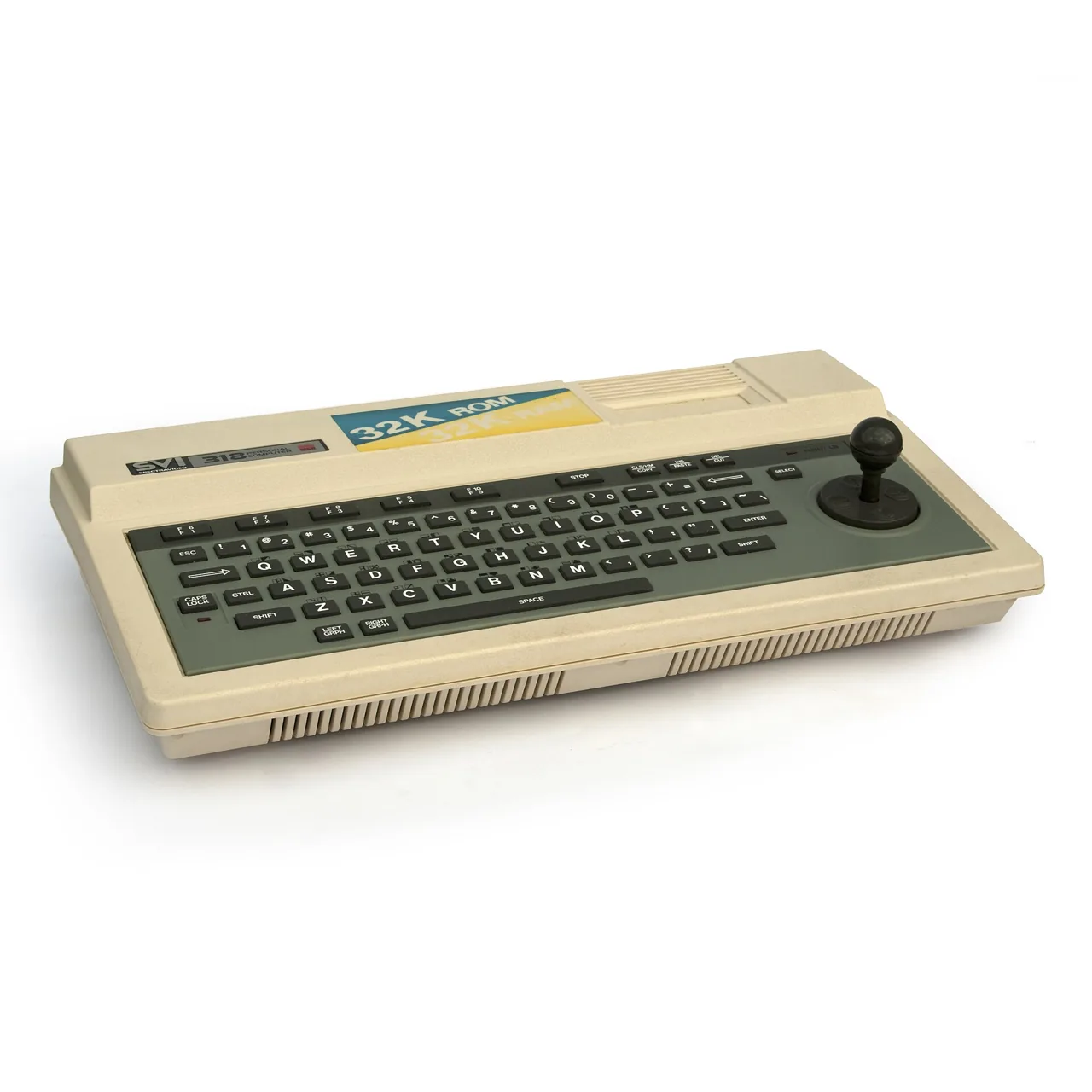
The Spectravideo SV-318, introduced as the company’s first home computer, shipped with 32K RAM expandable to 144K and featured a built-in red joystick that became its visual signature62. Priced at $299, it targeted the entry-level market14. Its sibling, the SV-328, offered 80K RAM and was positioned as the professional model, sharing nearly identical hardware with the later MSX-standard SV-72826. The SV-328 included a full-sized keyboard with numeric keypad, and the two models were so similar in construction that they were “hardly distinguishable,” differing primarily in bundled software, with the SV-328 using Microsoft Basic and the SV-728 using MSX Basic6.
The SV-728 conformed to the MSX standard with a Z80A CPU running at 3.6 MHz, 80K total memory (64K user RAM and 16K video RAM), and 32K ROM containing an MSX Basic interpreter featuring over 140 commands1. It supported both MSX-DOS and CP/M 2.2 when equipped with a disk drive, and included peripheral options such as an 80-column card and 5¼-inch floppy drive1. Graphics resolution reached 256×192 pixels with 16 colors and 32 programmable sprites, while sound was handled by three channels spanning eight octaves each1. The 90-key full-stroke keyboard included a numeric keypad and ten user-definable function keys1.
An unspecified Spectravideo model detailed in NZ Bits and Bytes matched the SV-728’s core specifications: 80K RAM, 32K ROM, MSX Basic with over 140 commands, 256×192 graphics, 32 programmable sprites, and three sound channels with programmable envelopes for effects9. It also included a cassette interface, Centronics printer port, MSX cartridge expansion, and a 90-key full-stroke keyboard with ten functions accessible via five special keys9.
The X’PRESS model shipped with both MSX-DOS and CP/M 2.2, the latter including a faster printer/spooler in release 2.07.
Spectravideo also ventured into IBM PC-compatible systems under the Bondwell name. The Bondwell 34 was a 16-bit desktop with 256K memory, dual 5¼-inch double-sided double-density floppy drives, an 80-column monochrome monitor interface, and a Centronics parallel port5. It bundled GW-BASIC and MS-DOS and carried a suggested retail price of $1,795, with a planned October release5. The Bondwell 36 retained most of the 34’s features but replaced one floppy drive with a 10-megabyte hard disk, increasing the price to $2,9955. Both were marketed as IBM PC-compatible 16-bit desktops5.
Another unspecified model, the MSX Express, reportedly featured a 3½-inch floppy drive, 64K RAM, a 73-key keyboard, and 80-column display support, with a planned price of $5955. Despite early announcements, delivery of Spectravideo’s MSX line, showcased in full at the Firato trade show, was delayed due to unspecified causes, though immediate availability had been expected1.
Spectravideo operated as an American company headquartered in California, but manufacturing was contracted to Hong Kong, where Bondwell Holding Ltd. served as the financial backer16. Harry Fox held leadership at the company, while industrial representation in Germany was managed by Mr. Jöllenbeck6. The company positioned itself uniquely among MSX adopters by aiming to serve both home and professional markets simultaneously, a dual focus no other MSX vendor pursued1.
References
- msx computer magazine 01
- NZ-bits-and-bytes-issue-2-10
- msx computer magazine 16 aug 1987 (1987)
- msx computer magazine 16
- 1985 07 BYTE 10-07 Computers and Space (1985)
- MSX - der erste Heimcomputerstandard
- MSX Computer Magazine 02-1986 (1986)
- Family Computing Issue 01 1983 Sep (1983)
- NZ-bits-and-bytes-issue-4-01
- msx computer magazine 05 dec 1985 jan 1986 (1985)
- msx computer magazine 05
- msx computer magazine 19 dec 1987 (1987)
- msx computer magazine 19
- Electronic Games Issue 17 Vol 02 05 1983 Jul (1983)
- msx computer magazine 03
- msx computer magazine 12 dec 1986 (1986)