Apple Mac SE
Apple Computer, Inc. introduced the Macintosh SE as a performance-optimized evolution of the Macintosh Plus, featuring repositioned SIMMs, an FDHD drive, and a fan-cooled chassis with optional internal SCSI storage.
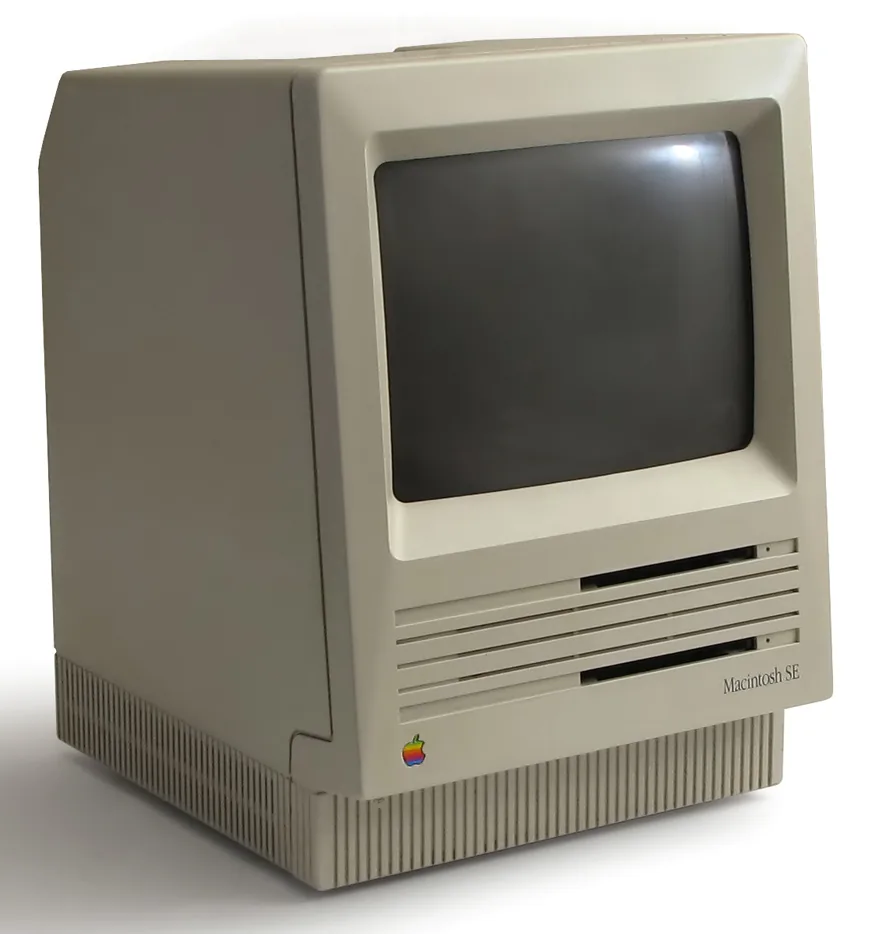
The Macintosh SE included active cooling, a higher-capacity 80-watt power supply, and a redesigned logic board using VLSI to consolidate circuitry and reportedly reduce production costs2. While retaining the Motorola 68000 CPU of its predecessor, Apple claimed a 15 to 20 percent performance improvement through optimized board layout and faster memory access2. RAM was mounted on slanted, repositioned Single In-line Memory Modules (SIMMs), with base configurations of 1 or 2 megabytes and upgrade paths officially supporting 2.5 and 4 megabytes1.
Storage flexibility defined the SE’s configuration options: users could choose two internal 800K floppy drives, or one 800K drive paired with either a 20 MB or 40 MB internal SCSI hard disk1. A notable enhancement over the Mac Plus was the standard inclusion of the high-density Apple Floppy Drive High Density (FDHD), capable of reading 1.4 MB disks; however, units shipped before August 1989 were equipped with the older 800K drive1. The SCSI subsystem featured improved hardware handshaking, and external SCSI hard disks were said to transfer data at twice the rate of those on the Mac Plus2.
The machine introduced the Apple Desktop Bus (ADB), with two rear-mounted connectors supporting detachable keyboards and mice; any ADB-compatible input device would function1. Expansion was limited but present: a snap-out rear door allowed for optional external I/O devices, and an internal connector provided access to the CPU bus for potential upgrades1. The 256K ROM included support for ADB, FDHD, SCSI, and AppleTalk enhancements1.
Priced at US$2,898 for the base model with 1 MB RAM and dual 800K drives, the SE jumped to US$3,698 when configured with a 20 MB hard disk25. In Australia, the equivalent configurations carried prices of A$5,320 and A$6,905 respectively25. Apple positioned the SE as a mid-tier offering between the Macintosh Plus and the modular Mac II, leveraging the existing Mac production line for immediate shipment2. Compatibility with over 90 percent of existing Mac software eased adoption25.
Network expansion was possible via third-party token ring cards, priced at $795 for the SE7. An FDHD Upgrade Kit, allowing owners of earlier SE models to retrofit the high-density drive, was available for $5997. Apple File Exchange (AFE) software, included in the system software package, enabled cross-platform file translation7. The SE laid the groundwork for the Mac SE/30, which replaced the 68000 with a 16-MHz 68030 processor and was designated the next generation in the compact Mac line1.
Specifications
| CPU | Motorola 68000 |
| Performance | 15–20% speed boost over Mac Plus (claimed) |
| RAM | 1 or 2 MB on slanted SIMMs; upgradable to 2.5 or 4 MB |
| ROM | 256 KB with ADB, FDHD, SCSI, and AppleTalk support |
| Internal Storage | Dual 800K floppy drives, or one 800K drive + 20 or 40 MB SCSI hard disk |
| Floppy Drive | Standard: FDHD (1.4 MB); pre-August 1989 models: 800K |
| Power Supply | 80-watt, wide input-range |
| Cooling | Internal fan |
| I/O | Two Apple Desktop Bus (ADB) connectors |
| Expansion | Snap-out rear port; internal CPU bus connector |
| SCSI | Improved handshaking; external drives transfer at ~2× Mac Plus rate |
| Original Price (US) | $2,898 (base); $3,698 (with 20 MB hard disk) |
| Original Price (Australia) | A$5,320 (base); A$6,905 (with hard disk) |
References
- PN 072-0228 Apple Service Technical Procedures Macintosh Family Volume One-Mar 1992 (1992)
- 1987.04 Your Computer (1987)
- 1987.04 Your Computer (1987)
- M6198C Macintosh Multivendor Network Solutions Guide 199008 (1990)