Atari STE
The Atari STE, released in 1990, was a cost-reduced and modestly enhanced variant of the Atari ST line, retaining the 8-MHz MC68000 processor while adding stereo sound, a 4,096-color palette, and expanded memory options up to 4 MB.
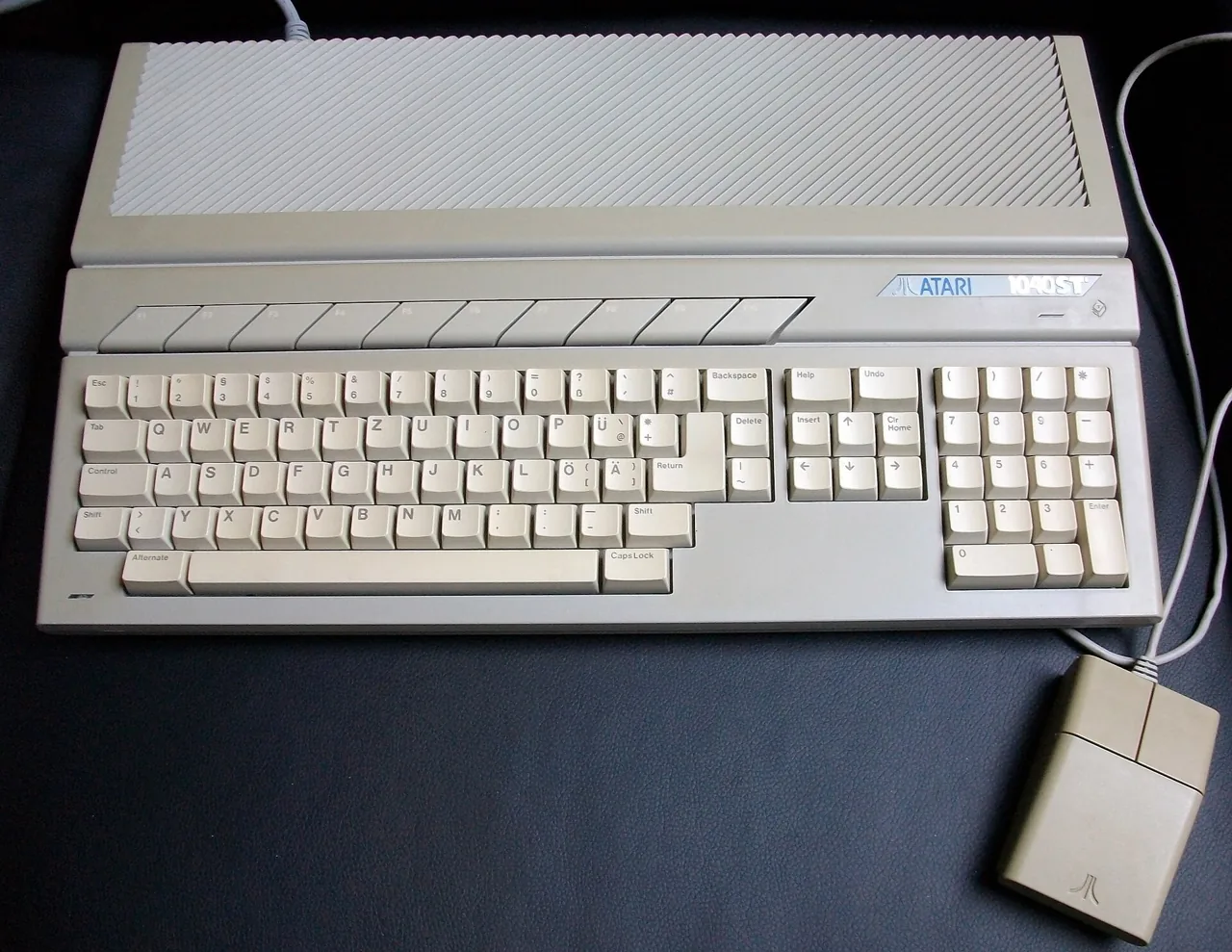
The STE designation stood for "Enhanced," though the enhancements were incremental rather than transformative9. It retained the same 16-bit data/24-bit address 8-MHz MC68000 microprocessor as earlier ST models, a deliberate choice confirmed in pre-release documentation: the STE would not adopt the 68020, preserving software compatibility at the expense of performance leaps seen in competing architectures10. Memory, however, was more generous. Base configurations included 512 Kbyte or 1 Mbyte RAM, with expansion via SIM modules supporting up to 4 MB163. The 520 STE shipped with 512 KB or 1 MB RAM depending on configuration, while 2 MB and 4 MB upgrades were offered as plug-in kits145.
Graphics retained the original ST’s resolutions (320 × 200 with 16 colors from a 512-color palette, 640 × 200 with 4 colors, and 640 × 400 monochrome) but added a 4,096-color palette for digitized image support, though only 16 colors could be displayed simultaneously3916. A dedicated 32 Kbyte BitMap video display memory and a graphics coprocessor assisted rendering. The system supported both RGB color and high-resolution monochrome monitors, labeled in documentation as "ST Niedrig (f)," "ST Mittel (f)," and "ST Hoch (s/w)"167. The built-in RF modulator included GENLOCK capability, allowing external video signals to be mixed with computer output, a feature targeted at video producers and educators3. Atari published a "Genlock and the STE" technical addendum, underscoring its intended role in multimedia workflows15.
Audio marked a clearer departure: the STE introduced stereo digital sound, a rarity among home computers of its class39. Developer documentation detailed "STE Digitized Sound Developer Information," acknowledging its appeal for music and audio applications15. The built-in MIDI interface, long a hallmark of the ST line, remained, and the Rhythmic Bytes catalogue listed the 1040STE/4MB configuration at $1,195.00, positioning it as a music production workstation6. The operating system, TOS 2.06 STE/STFM, was ROM-based and featured a graphical user interface standard across the line41113.
Atari marketed the STE through tiered bundles: the 520 STE Discovery Xtra pack at £299 included four games, three starter programs, and a joystick, aimed at younger users1. The Turbo games pack followed at £359, and the 1040 STE Family Curriculum pack at £3991. US pricing listed the base 520STE at $695.00 and the 1040STE at $925.00, with 2 MB and 4 MB variants priced higher6. Atari reduced the 520 STE price from £400 to £359, then to £299, as part of an aggressive marketing push1. At that price, ST Format claimed it was "the best value multi-purpose 16-bit computer on the market"1.
Physical design echoed earlier ST models, with an "intelligent keyboard" (model STFM-STE) and a two-button mouse (Atari Original Mouse)1641113. The motherboard included plug-in connectors for SIM modules, an on-board floppy disk controller with DMA support, and interfaces for hard disk drives, parallel printers, and RS232 serial devices16. The disk format maintained compatibility with MS-DOS platforms, a pragmatic nod to data exchange needs3. Features such as an ON/OFF memory switch and a battery-backed clock were available via upgrades, though exact dimensions and weight remain undocumented in surviving materials1.
Despite its enhancements, the STE occupied a transitional space. It shared the ST’s software ecosystem, supporting applications from WordPerfect to Microsoft Write, and retained backward compatibility, though a dual TOS switch (for TOS 1.0 and 1.4) was noted as incompatible with STEs14. The STE Developer Addendum and related technical guides suggest Atari anticipated developer investment, but the platform was soon overshadowed by the Mega STE and the more powerful Atari TT1578. The STI transputer add-on board was mentioned in promotional text, with details including a speed boost of some 80 times and a price of £5001. Ultimately, the STE was a refinement, not a reinvention. Its value lay in incremental upgrades delivered at a sharply reduced price point.
Specifications
| CPU | 8-MHz MC68000 processor (16-bit data/24-bit address) |
| RAM | 512 KB or 1 MB base; expandable to 4 MB via SIMMs |
| ROM | TOS 2.06 STE/STFM (ROM-based) |
| Display | 320 × 200 (16/512 colors), 640 × 200 (4/512 colors), 640 × 400 monochrome; 4,096-color palette |
| Video Memory | 32 KB BitMap display memory |
| Sound | Stereo digital sound, supports external stereo speakers |
| Storage | One double-sided microfloppy drive; MS-DOS disk format compatible; DMA support |
| I/O | MIDI, RS232 serial, parallel printer, RGB/monochrome monitor, GENLOCK |
| Keyboard | Atari STFM-STE intelligent keyboard |
| Mouse | Atari Original Mouse (two-button) |
| Operating System | TOS 2.06 STE/STFM (ROM-based) |
References
- atari-st-format-issue-024
- ST magazine 093
- 1040STe Personal System brochure
- atari-st-format-issue-051
- ST-Computer 1991-05 (1991)
- Rhythmic Bytes MIDI Music Catalogue Summer 91-92
- Archive item #9207text
- Archive item #9210
- Computers that made Britain v1
- Analog Computing 79 1989-12 Double Megafile Storage (1989)
- ST Applications #34, October 1993 (1993)
- Archive item #64er199007
- Atari ST User Issue 097 1994-02 Europress GB (1994)
- XIO3 Garden City Atari Computer Enthusiasts Newsletter July - August 1993 (1993)
- Atari ST(E)-TT Toolkit - B1-00 - Contents (1991)(Atari)(NL) (1991)
- GEM 0904