MSX
The MSX was a standardized home computer architecture introduced in 1983 by a consortium led by Spectravideo and adopted by National, among other Japanese electronics firms, with the goal of creating a unified platform for software and hardware compatibility.
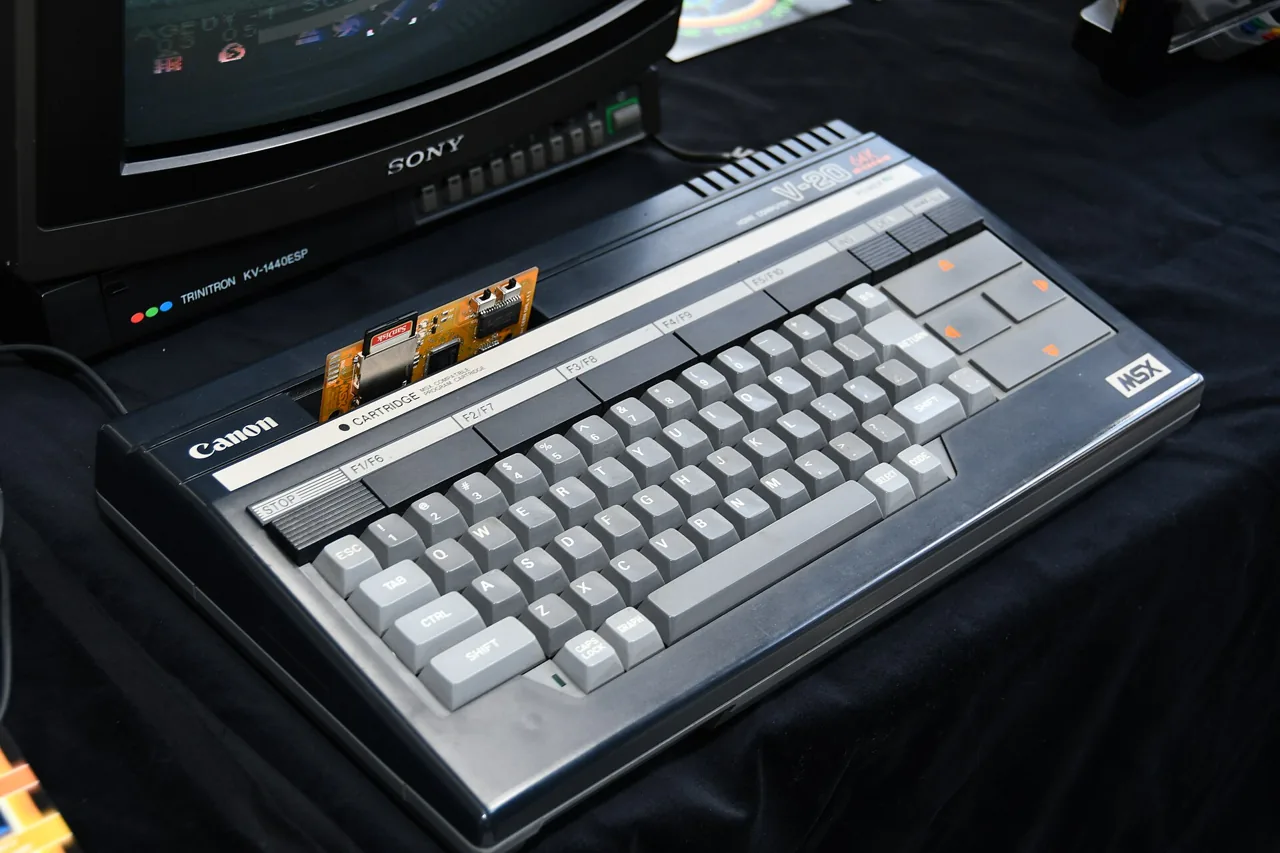
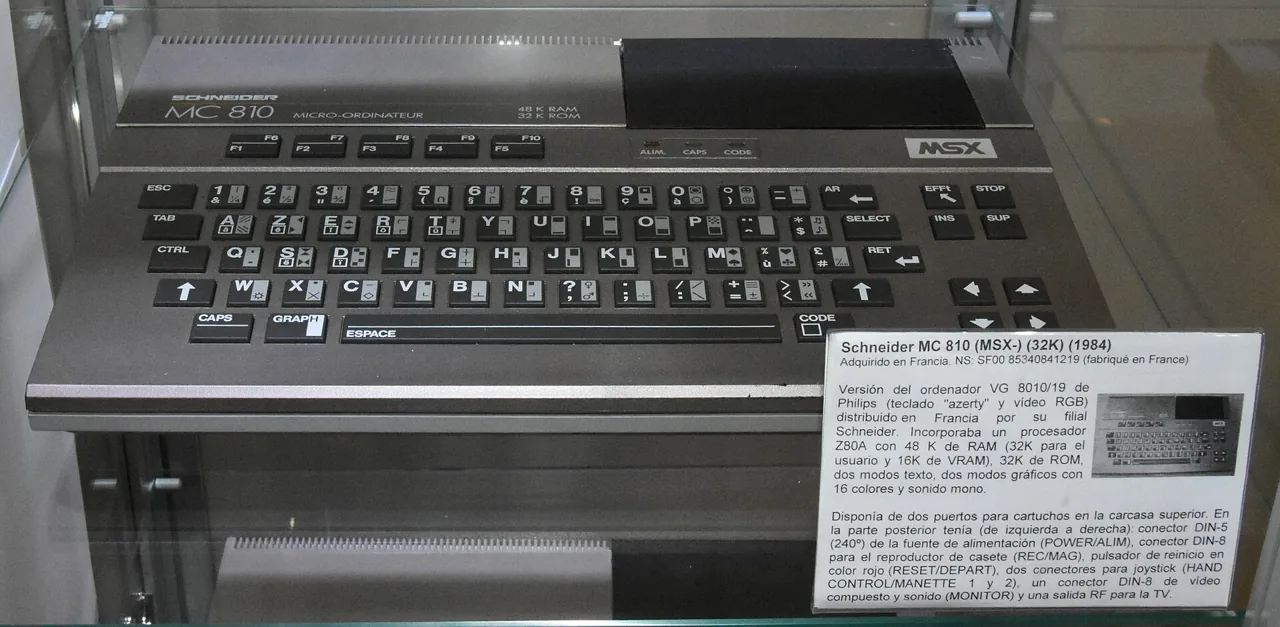
National launched its first MSX machine in October 19831 priced at 54,800円1, featuring 16 KB of RAM and 16 KB of dedicated video RAM111. It ran an MSX-BASIC interpreter11 and included two ROM cartridge slots1, conforming to the baseline specification of early MSX systems1. The CPU was a Z80A running at 3.5 MHz, as confirmed in documentation for the Philips VG8020 MSX model11, though the exact clock speed for National’s initial unit is not explicitly recorded. The video subsystem relied on a Texas Instruments TMS-9129 or functionally equivalent Video Display Processor11, while sound and peripheral control were handled by a Yamaha S-3527 or similar chip serving as both PSG and PPI11.
The MSX standard was conceived from the Spectravideo SV-31810, which served as the hardware prototype10. On June 15, 1983, Spectravideo, Inc. formally joined with major Japanese electronics manufacturers to announce the platform10, aiming to establish what one contemporary magazine called “the most far-reaching personal computer standard in history”10. National initially branded its MSX line under the name “King Kong” (キングコング), using the character in advertising1, before transitioning to the Panasonic brand as its CF-series word processor-integrated models gained market presence1.
Subsequent National MSX models included the MSX ROM ×2, released in October 19841 at 59,800円1, and a cost-reduced version in 1985 priced at 43,800円1, retaining 16 KB of RAM but offered in red, white, and black color variants1. The CF-2000 model marked a design shift with increased memory and a linear wedge-shaped case that became the template for National’s MSX1 lineup1. User memory was available from &H8000 to &HFFFF, though portions were occupied by the MSX-BASIC interpreter11.
Software support included built-in MSX-BASIC11 and an operating system referred to simply as the MSX operating system69. Titles such as Invaders, Breakout, Squash, Othello, and Bioritme were available6, along with financial applications like Beleggen, Sparen, Lenen, and Bedrijfsanalyse6. Technical documentation such as THE MSX RED BOOK by Avalon Software covered Z80 programming, RAM/ROM routines, and the MSX operating system69. MSX-DOS 2.20 was the sole authorized release of MSX-DOS216, with ASCII granting non-exclusive licenses to partners such as HSH, which became a licensee in early April of an unspecified year16. No other MSX products were licensed to independent entities in Europe at that time, nor was a licensed hard disk interface available there16.
The CALL STREET feature is mentioned in the source material, though its function and implementation are not detailed1. The surviving documentation is silent on I/O ports, expansion capabilities, display resolution, text modes, keyboard layout, physical dimensions, weight, and production volumes. No end-of-life date or discontinuation information is recorded in the provided sources.
References
- MSX パーフェクトカタログ
- msx computer magazine 07
- msx computer magazine 07 apr 1986 (1986)
- Family Computing Issue 01 1983 Sep (1983)
- Philips VG8020 MSX computer
- msx computer magazine 08
- msx computer magazine 31 jul aug 1989 (1989)