Timex Sinclair 1000
The Timex Sinclair 1000, a 2K-memory home computer manufactured by Timex and based on Sinclair ZX80/ZX81 design, launched in the early 1980s as a sub-$50 entry into personal computing, though retail prices varied widely across outlets and time.
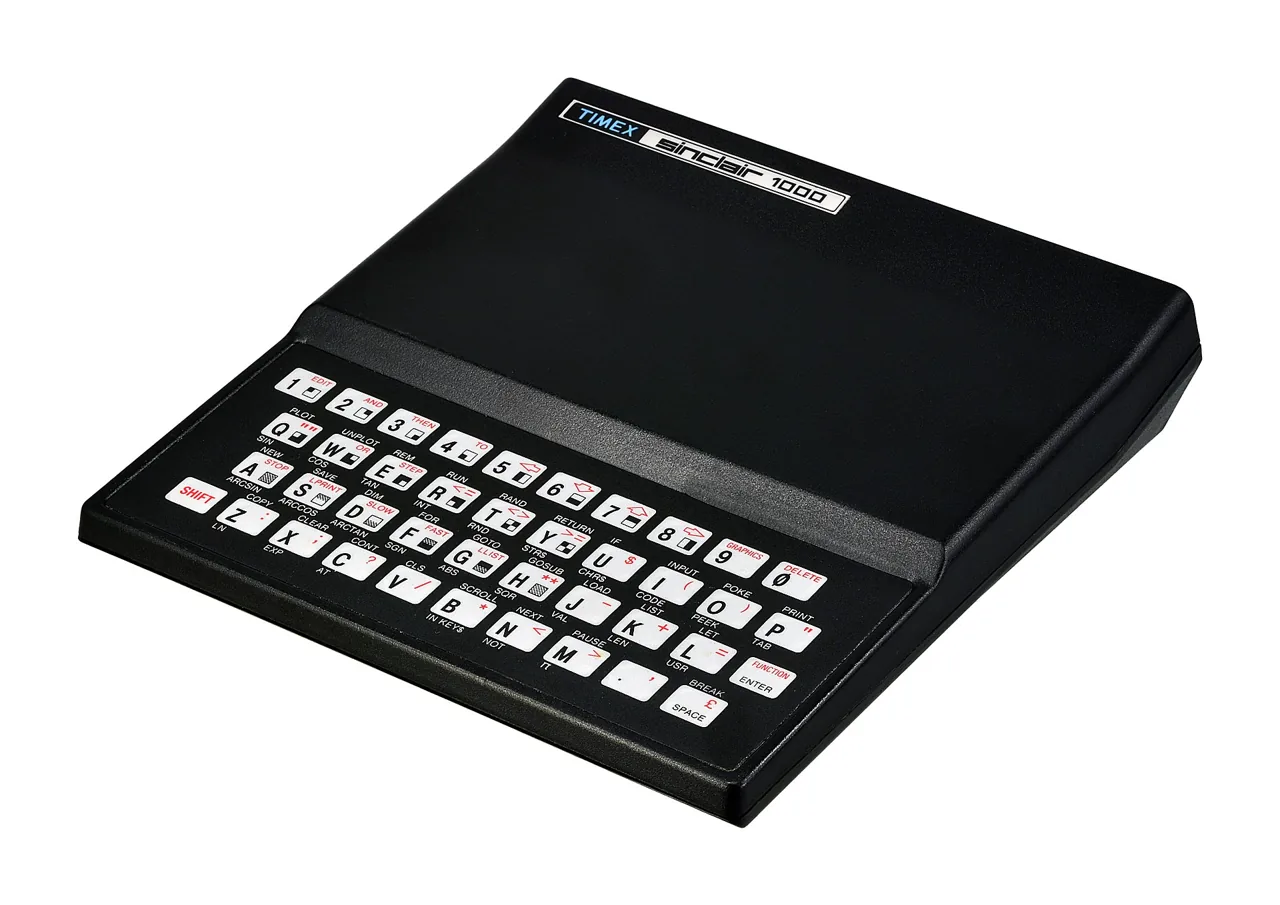
Market positioning for the Timex Sinclair 1000 rested on radical affordability, though surviving documentation reveals a confusing array of price points. Advertised as "under $50" upon introduction3, it was simultaneously listed at $89.00 in period publications131415, while other sources cite $39.008 and even $24.991011. A year prior to one 1983 report, the same machine had reportedly sold for $998, suggesting aggressive price erosion or regional variance. The manufacturer, Timex Corporation, also referenced as Timex Computer Corporation, positioned the device as a "programmable home computer" with "limited power"3, explicitly framing it as the "younger brother of the Sinclair ZX80"3, itself a design by Clive Sinclair3.
The system centered on an 8-bit Z-80 microprocessor3 and exactly 2.048 built-in bytes of internal memory57, a figure slightly improved over the ZX81's 1K7. This memory could be expanded to 16K via the Timex Sinclair 1015 module, priced at $49.9557, though the base unit's 2K severely constrained immediate utility. The machine featured a membrane keyboard2, a design choice common to ultra-low-cost systems but widely criticized in practice for poor tactile feedback, though no primary source in the fact sheet records user complaints. Storage relied on standard audio cassette tapes via any compatible recorder5, and software compatibility with the Sinclair ZX81 was a key selling point: ZX81 programs ran directly on the 10005, and Timex pledged to expand the library with new releases57.
Peripherals formed a critical upgrade path. The Timex Sinclair 2020 thermal printer retailed for $99.9557, and a $99.95 modem enabled automatic dialing through phone lines5. A communications interface was expected "shortly" after launch7. Third-party support emerged quickly; data-assette advertised a "FULL RANGE of LOW COST products" compatible with the system2, including software packages such as the $1 "Fun and Games Package"6 and the $14 "Tax Return Helper" on cassette6. The included 154-page User's Manual was noted as "excellent" and tailored for beginners5.
Production ran at industrial scale: units rolled off the line at a rate of one every ten seconds7, distributed through more than 100,000 retail outlets beginning with computer stores7. One 1982 prediction estimated up to one million units might be in circulation by the end of the following year7. Timex used the 1000 to fuel a price war, having previously cut prices on the TS/100 (a ZX81 variant)8. A successor model, the TS/1500, was announced to fill the gap between the 1000 and the more advanced TS/20008, the latter featuring banked memory, a 64x24 display, ROM cartridge support, and an upper/lower case keyboard8.
Despite its ambitions, the 1000's technical constraints drew quiet skepticism. One contemporary assessment noted that calling it "full feature" stretched credibility3, and its place in a market where computers ranged from $50 to $1,000 highlighted its role as an entry-level appliance rather than a serious machine3. Yet it fulfilled its mandate: it demonstrated that a programmable computer could cost less than many home entertainment systems3. The fact sheet contains no data on dimensions, weight, display resolution, sound, I/O ports, or operating system, and exact release or discontinuation dates remain undocumented in the provided sources.
References
- ReadersGuideMicrocomputerBooks MichaelNicitaRonaldPetrusha
- Data-assette flyers
- Introducing IBM PCjr
- gccc41 1nl
- Electronic Fun Computer and Games Vol 01 01 1982 Nov (1982)
- 1983 03 BYTE 08-03 Mass Storage (1983)
- 1982 08 BYTE 07-08 Logo (1982)
- Archive item #198308
- 1983 04 BYTE 08-04 New Chips (1983)
- micro 69 feb 1984[ocr] (1984)
- 1984 03 BYTE 09-03 Simulation (1984)
- MICRO Vol72-06 84
- MICRO Vol55-12 82
- micro 55 dec 1982[ocr] (1982)
- 1982 12 BYTE 07-12 Game Plan 1982 (1982)
- MICRO Vol71-0405 84