Sun SPARC
Sun Microsystems developed the SPARC processor architecture as a 32-bit design later extended to 64-bit in Version 9, establishing a scalable family of chips anchored by the UltraSPARC at the high end and supported by an ecosystem of licensed trademarks and cross-platform development tools.
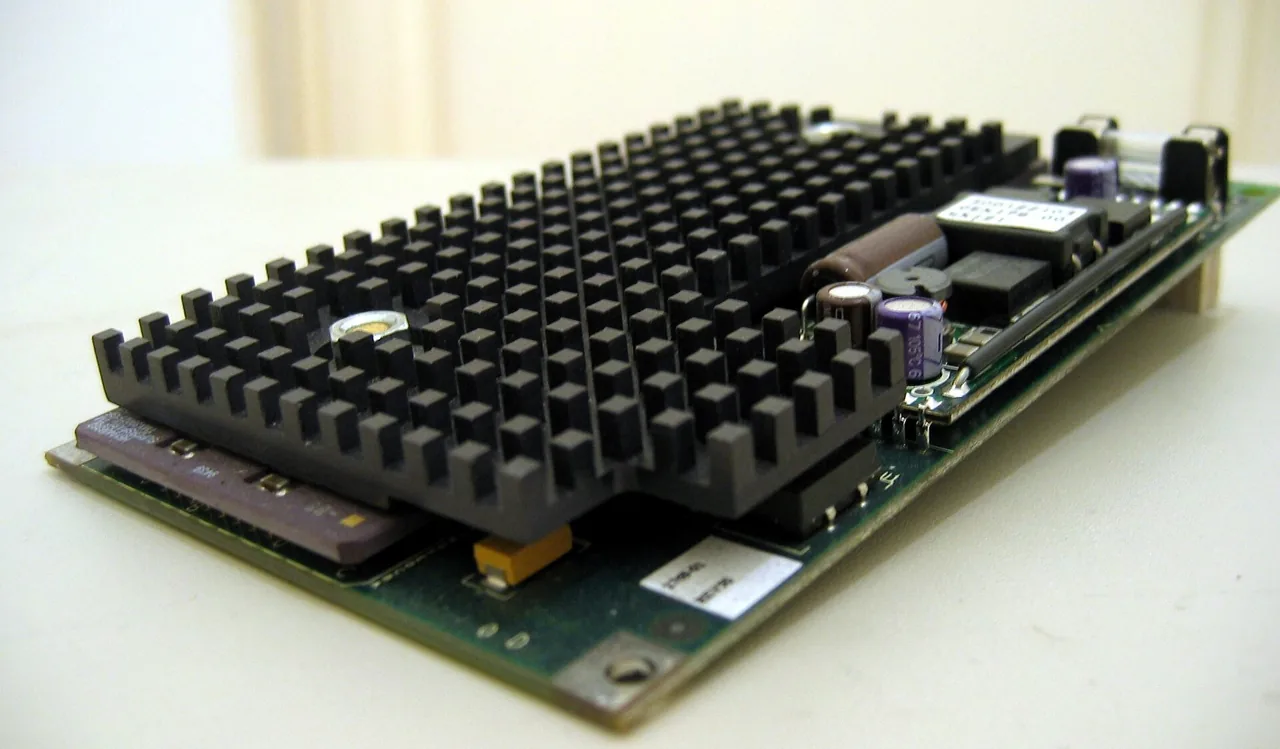
SPARC, or Scalable Processor Architecture, was Sun Microsystems’ in-house RISC design, first deployed in the Sun-4 series of workstations and servers13. The earliest documented SPARC implementations, such as the Sun-4/100 and Sun-4/200, featured 32-bit architectures with integer units clocked at 14.28 MHz and 16.67 MHz respectively13. For the Sun-4/200, the MB86900 handled integer operations, the MB86910 served as the floating-point controller, and the Weitek 1164/1165 provided floating-point arithmetic; the Sun-4/100 used an unspecified integer unit and included a floating-point controller with Weitek 1164/1165 floating-point arithmetic units13. The Sun-4/200 included a 128-KByte write-back cache and supported high-resolution monochrome output at 1600 x 128013, a rarity in its class at the time.
By 1993, Sun had restructured around SPARC as a strategic platform, forming the SPARC Technology Business group within SMCC to drive industry adoption11. That same year, Sun outlined a tiered roadmap: the high-end UltraSPARC, the mid-range SuperSPARC (in at least three models), and the low-end microSPARC (in three performance tiers)11. Derek Myer, Sun’s director of SPARC marketing, projected a future chip capable of 800 SPECint92 and 1,000 SPECfp92 within three to four years11. The UltraSPARC, as of 1994, was expected to deliver 200 to 400 SPECint92 and 250 to 500 SPECfp922.
SPARC Version 9, introduced in 1994, marked a generational shift. It mandated a 64-bit system, superscalar execution, and on-chip support for advanced operating system features such as microkernel architectures and lightweight threads2. It also included silicon-level optimizations for advanced compilers2. Notably, Version 9 was formally the product of SPARC International, Inc., a standards body formed by Sun and partner firms, though the architecture originated within Sun Microsystems23410121516.
Software development for SPARC systems was facilitated by cross-compilation tools. Prior to the field availability of Sun-4 hardware, third-party developers used cross-compilers to port software14. Sun-4 systems could act as either host or target in cross-development environments alongside Sun-2 and Sun-3 systems14. Cross-Compilers release 2.0 formalized this capability14. The SPARC platform ran SunOS 4.x, SunOS 5.x, and Solaris 1.x or 2.x, with application development supported under Open Windows 3.0 or later1.
Trademark control remained tightly held. SPARCstation, SPARCserver, SPARCengine, SPARCcenter, SPARCclassic, SPARCworks, and SPARCompiler were licensed exclusively to Sun Microsystems10. The SPARC Station trademark was similarly restricted3412. WEITEK Corporation was permitted to use the SPARC POWER trademark under license3415.
The SPARC architecture was never a single chip but a family of implementations unified by specification and licensing. Its design allowed segmentation across performance tiers while maintaining binary compatibility, a goal more aspirational than consistently achieved in practice. The reliance on external FPU vendors like Weitek introduced integration complexities, and the absence of published transistor counts, process nodes, or package details in surviving documentation leaves technical depth obscured. Yet SPARC’s influence endured through its standardization model and Sun’s aggressive positioning of it as a scalable, open alternative to proprietary architectures.
References
- 801-3206-10 SPARCompilerSPARCworksProductNotes RevA Oct92
- SunExpert-v05n11-1994-11 (1994)
- SunExpert-v05n07-1994-07 (1994)
- SunExpert-v05n05-1994-05 (1994)
- SunExpert-v05n08-1994-08 (1994)
- SunExpert-v05n06-1994-06 (1994)
- SunExpert-v05n12-1994-12 (1994)
- SunExpert-v05n04-1994-04 (1994)
- SunExpert-v05n02-1994-02 (1994)
- SA-285 StudentGuideRevBJul93 SystemAdministrationII
- SunExpert-v04n04-1993-04 (1993)
- SunExpert-v03n06-1992-06 (1992)
- Sun US Price List Dec88
- 812-8801-02 - Software Technical Bulletin February 1988 (1988)
- SunExpert-v05n03-1994-03 (1994)
- 804-5304-11 RevA SunFastEthernet Adapter 2.1 CD Booklet Jul96