Zilog Z8000
Zilog’s first 16-bit microprocessor, the Z8000, was engineered from the ground up to challenge minicomputer dominance, replicating it in silicon.
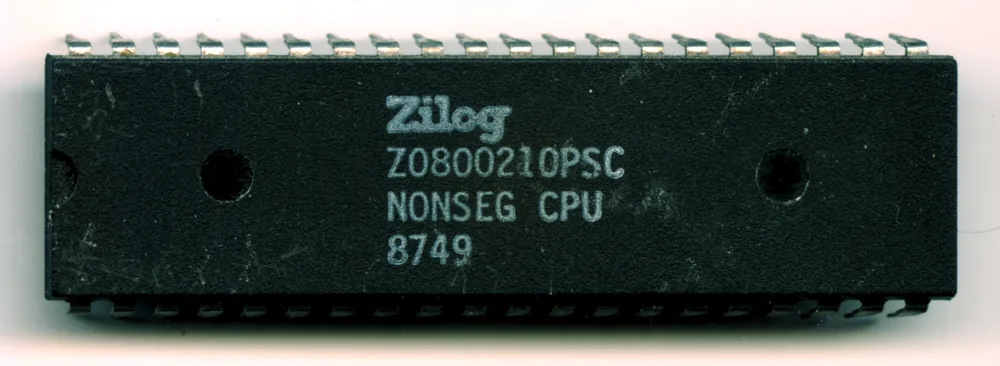
The Z8000 differed from its contemporaries in philosophy as much as in function. While other manufacturers adapted existing 8-bit designs or downscaled minicomputer architectures, Zilog started fresh, incorporating advanced features from systems like the DEC PDP-11 and IBM 370 into a native 16-bit microprocessor design2. This was not a scaled-down minicomputer. It was a microprocessor built to operate in the minicomputer’s domain, targeting high-end applications from the outset2. Its repertoire of 110 unique instructions included sophisticated macroinstructions for block searches and string manipulations, capabilities rare in microprocessors of the era2.
Performance claims were bold but grounded: a 4 MHz Z8000 reportedly delivered two to five times the throughput of a PDP-11/35 and could surpass the PDP-11/45 in many tasks2. At 8 MHz, the memory cycle time was 500 ns, a competitive figure for the period2. The processor came in two physical configurations: a 40-pin version supporting 16-bit addressing, and a 48-pin variant enabling access to up to 48 megabytes of memory via a segmented 24-bit address space2.
A defining architectural feature was the Extended Processing Architecture (EPA), standard on all Z8000 CPUs1. EPA permitted the attachment of up to four Extended Processing Units (EPUs), which executed specialized tasks (such as floating-point arithmetic or I/O control) in parallel with the main CPU1. These EPUs were managed through a single instruction stream in the CPU, requiring no external logic for coordination, simplifying system design1. This modularity presaged later coprocessor and accelerator trends, though it demanded careful software orchestration.
The Z8000 was not a standalone chip but the nucleus of a broader ecosystem. The family included the Z8001/2 CPU, Z8010 MMU, Z8030 SCC, Z8060 FIFO, Z8090 UPC, and the Z8536 CIO Counter/Timer and Parallel I/O Unit, among others1314. These peripherals adhered to Z-BUS protocols, ensuring consistent bus timing and size control across the system8. Development tools were available: Zilog offered the PL/Z high-level language and the PLZ/ASM assembly language, with manuals such as the Z8000 PLZ/ASM Assembly Language Programming Manual (03-3055) and tools like macroassemblers, cross-assemblers, and linkers from third parties such as 2500 A.D. Software2615. Compilers for BASIC, COBOL, and FORTRAN were in development, and the Z8000 was listed as a target for a Zilog C compiler27.
The Z8000 found use in dedicated development systems such as the System 8000 ZEUS, which ran a Z8000-based operating system for software development tasks31112. The ZEUS system included language translators such as the PLZ/ASM as and development module libraries, indicating a mature, albeit niche, software environment6. It also powered the System X8000 MICRO-MINI, a machine designed to be Intel Multibus compatible, suggesting integration into industrial or telecommunications backplanes9. A TCP/IP network controller referenced in 1985 used a Z8000 microprocessor box interfaced to UNIX systems via a UMC-Z8, underscoring its role in early networking infrastructure4.
Zilog’s influence extended beyond hardware. The company originated calling conventions for the Z8000 that were later adopted by Microsoft, a rare instance of a microprocessor vendor shaping software standards at that level5. These conventions were reportedly under consideration by several other firms, suggesting a brief window where the Z8000’s architecture could have become a de facto standard5.
Despite its technical ambition, the Z8000 never achieved mass-market penetration. The surviving documentation is silent on production volumes, pricing, and exact release timeline. Its complexity, segmented memory model, and the rise of competing architectures likely limited its reach. Yet it remains an example of a design philosophy unencumbered by backward compatibility: a microprocessor built not to fit the market, but to redefine it.
References
- Microprocessor Data Hand Book
- MicrocomputerInterfacing BruceArtwick
- 03-3255-01 System 8000 ZEUS Reference Manual Rel 3.1 198305 (1983)
- NIC50002 September1985 (1985)
- 1981 04 BYTE 06-04 Future Computers (1981)
- 03-3249-01 System 8000 ZEUS Languages - Programming Tools Rel 3.2 198305 (1983)
- AUUGN-V05.5
- BYTE Vol 09-01 1984-01 1984 And Beyond (1984)
- 1981 02 BYTE 06-02 The Computer and Voice Synthesis (1981)
- Programming The M68000 1983 Addison-Wesley Publishing Company (1983)
- 03-0263-02 Note To User For ZEUS 3.21
- 03-3199-01 System 8000 User Manual Mar1982 (1982)
- V1600-1A PGX MVME1603 MVME1604 Prog Ref Nov94
- 074 - Nova Eletronica - Abr 1983 (1983)
- 1984 03 BYTE 09-03 Simulation (1984)
- PPCBUGA Firmware Package Feb2001 (2001)