Zilog Z8001
A 16-bit segmented microprocessor from Zilog, designed for multiuser systems running early UNIX derivatives.
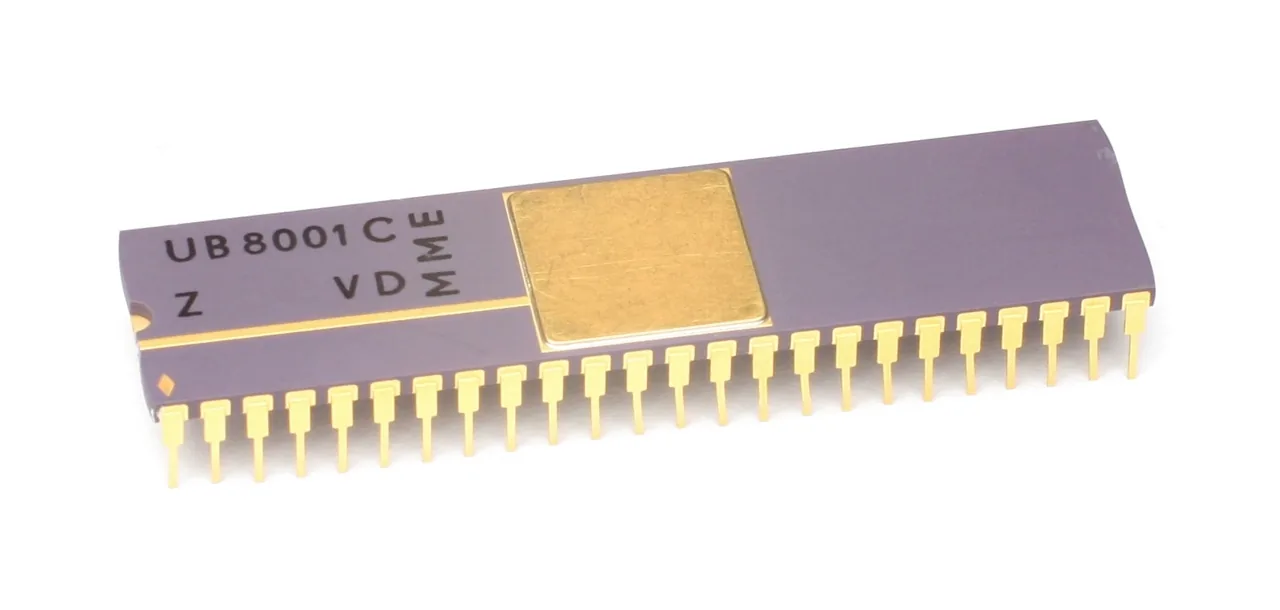
The Z8001 was not a general-purpose CPU in the mold of its more famous 8-bit siblings. It was a segmented 16-bit processor built for multitasking environments where memory protection and relocation were non-negotiable. Unlike the Z8002, a 40-pin sibling with a truncated address space, the Z8001 used a 48-pin DIP or LCC package and supported a full 23-bit segmented logical address, splitting each address into a 7-bit segment number (SNO–SN6) and a 16-bit offset, allowing access to 128 relocatable segments of up to 64 Kbytes each12. This structure gave it a direct reach of 8 megabytes of memory1311, extendable to 48 megabytes in system configurations1, an ambitious figure for the early 1980s.
Clock speed reports diverge: one source specifies 5.5 megahertz7, another states 6 MHz11. The Zilog System 8000 Models 21 and 31, both based on the Z8001A variant, reportedly ran at 6 MHz11. Fabricated using high-density, scaled n-channel silicon-gate depletion-load technology1, the chip was register-oriented, with sixteen 16-bit general-purpose registers, each capable of acting as an accumulator, and all but one usable as index registers or memory pointers111. It supported 8-, 16-, and 32-bit data operations11, a flexibility uncommon in 16-bit contemporaries.
Segmented addressing was not optional; it was the architecture. The CPU operated in segmented mode by design, generating addresses with variable segment numbers across code, data, and stack spaces2. Two operating modes, system and normal, enabled privilege separation, while features like the atomic Test and Set instruction facilitated multiprogramming and multiprocessing1. The Z8010 Memory Management Unit, a companion IC, was optional but typical in deployments, providing segment relocation and memory protection15. Systems such as the SST integrated the Z8010 MMU alongside the Z80015, and the Z8010A variant appeared in later configurations311.
The Z8001 found its niche in multiuser workstations. Tri-Data Systems of City of Industry, California, was the first to announce a microcomputer based on the Z8001 running Microsoft’s Xenix operating system5. Zilog’s own System 8000 series, Models 21, 31, 21 Plus, 31 Plus, 12, and 22, were all built around the Z8001 or Z8001A237811, and shipped with ZEUS (Zilog Enhanced UNIX)278. Fujitsu marketed the System 8000/11 PLUS and related models in 1986, indicating a lifespan that extended at least into the mid-1980s4.
Despite its capabilities, the Z8001 remained obscure outside specialized installations. One technician’s note dismisses a machine bearing it as “not a true IBM clone, as it had a Zilog Z8001 CPU”12, a backhanded acknowledgment of its architectural divergence. The Z8000 family included peripheral controllers like the Z8420 PIO, Z8430 CTC, Z8440/1/2 SIO, and Z8030 Z SCC10, but the platform never achieved broad compatibility or second-source production. The surviving documentation is silent on price, transistor count, process node, and sales volume.
Specifications
| Processor | Z8001A 16-bit microprocessor237811 |
| Clock speed | 5.5 MHz7 or 6 MHz11 |
| Addressing | 23-bit segmented logical addresses23 |
| Segment size | Up to 64 Kbytes per segment3 |
| Segments | 128 relocatable segments3 |
| Total address space | 8 Mbyte segmented addressing space1311 |
| Extended memory | Up to 48 megabytes1 |
| Registers | Sixteen 16-bit general-purpose registers111 |
| Data operations | 8, 16, and 32-bit11 |
| Package | 48-pin dual-in-line (DIP) and leadless chip carrier (LCC)1 |
| Fabrication | High-density, high-performance scaled n-channel silicon-gate depletion-load technology1 |
| Companion IC | Z8010 or Z8010A Memory Management Unit13511 |
References
- Microprocessor Data Hand Book
- 03-3199-01 System 8000 User Manual Mar1982 (1982)
- 03-3200-01 S8000cpuHw Sep82
- Fujitsu Sales Prospector 1986 (1986)
- 1981 02 BYTE 06-02 The Computer and Voice Synthesis (1981)
- 03-3249-01 System 8000 ZEUS Languages - Programming Tools Rel 3.2 198305 (1983)
- 03-3198-01 System 8000 Hardware Reference Manual Mar1982 (1982)
- 03-3237-06B M21 M31hw Apr84
- ComputerPersoenlich 83 19
- 074 - Nova Eletronica - Abr 1983 (1983)
- AUUGN-V05.3
- pc engineers vol1 BIOS