Commodore SID 6581
The MOS 6581 Sound Interface Device (SID) was a single-chip music synthesizer developed by Commodore’s MOS Technology Division, forming the sonic core of the Commodore 64 and enabling programmable polyphonic sound unmatched in home computing at its debut.
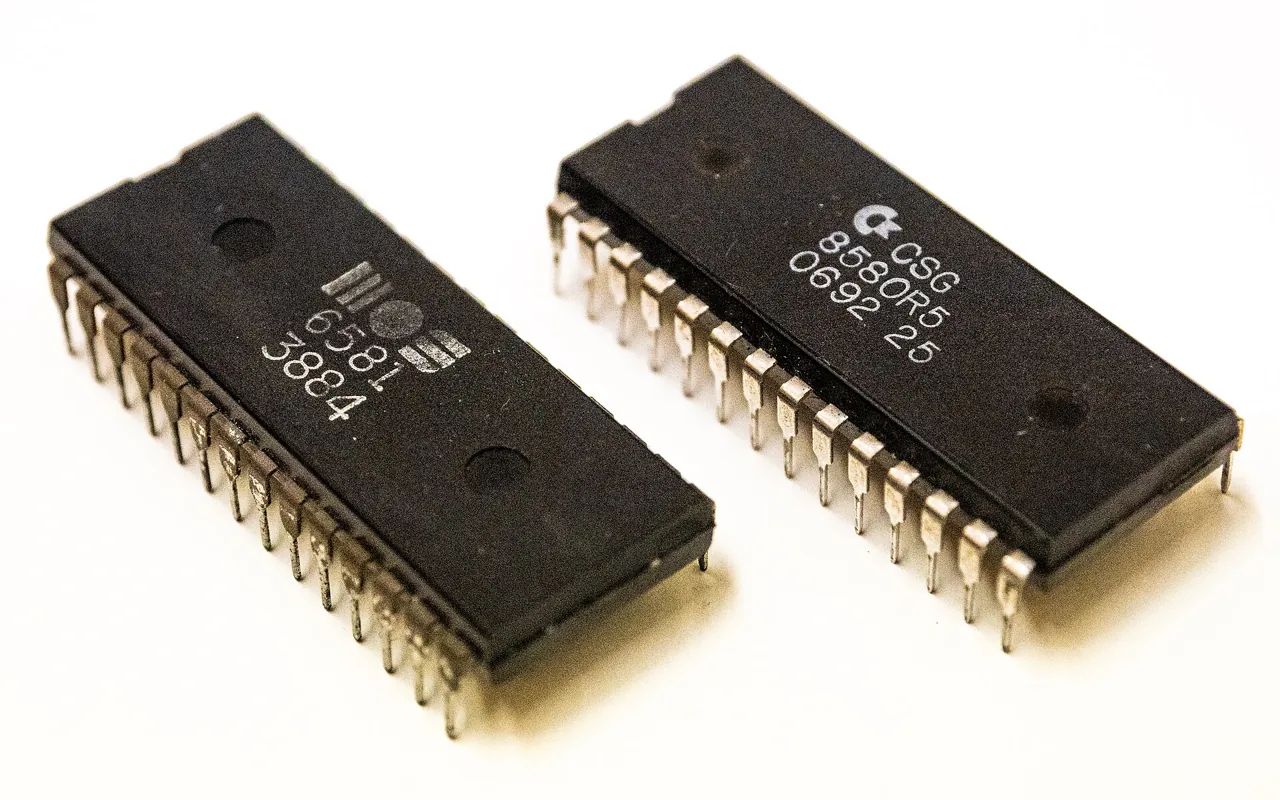
The SID 6581 was immediately hailed as “one of this year’s most exciting new pieces of computer hardware” by Commodore Magazine (Australia)1. It integrated three independent voices, each with a tone oscillator, envelope generator, and amplitude modulator, allowing for true polyphony in a consumer machine, a rarity at the time12. Each voice supported four waveforms and programmable ADSR (Attack, Decay, Sustain, Release) envelopes, giving composers granular control over sound shaping29. The chip’s ability to combine two tone generators for modulation effects enabled complex timbres, blurring the line between video game audio and professional synthesis1.
The SID 6581’s filter was its secret weapon: a filter capable of routing any combination of the three voices, acting as a “super tone control” that could sculpt sound with warmth and resonance unusual for digital systems1. Unlike most contemporaneous sound chips, it included an external audio input, allowing musicians to process signals from instruments like electric guitars directly through its filter, a feature exploited in later experimental music1. The chip also contained two A/D converters, electrically isolated from the sound circuitry but usable for reading potentiometers, a quirk later repurposed for custom game controllers1.
Manufactured using NMOS technology by Commodore’s MOS Technology Division, the SID 6581 was designed for ease of interfacing, notably with the SYM-1 development board2. It became standard equipment in the Commodore 64, where it shared the board with the 6510 CPU, 6526 CIA, and 6567 VIC II video chip, forming a tightly integrated system13. Later revisions saw the 8580 SID replace the 6581 in newer models9.
Despite its capabilities, documentation was sparse. As late as 1985, RUN magazine noted that “understanding sound is terribly difficult; often little to nothing is found about the SID chip in books about the C64”48. Yet software like Synthimat 64 demonstrated that, when fully exploited, the SID 6581 could “surpass genuine sound machines” in flexibility and sonic character48. By the 2000s, its legacy was cemented: the High Voltage SID Collection (www.hvsc.c64.org) preserved a vast archive of SID-based compositions, while C64-derived audio CDs like the Back in Time series and Reyn Ouwehand’s Nexus 6581 proved its enduring appeal14.
The chip’s reputation rests on a paradox: a mass-market component engineered for cost control that accidentally achieved cult status among electronic musicians. As one retrospective put it, the SID 6581 conferred “sublime quality to music” and remains on par with many genuine synthesizers1348. It was more than a sound chip: a compositional instrument and the heart of the Commodore 64’s lasting sonic allure10.
Specifications
| Manufacturer | Commodore's MOS Technology Division2 |
| Technology | NMOS2 |
| Voice count | 312 |
| Sound resolution | 8-bit9 |
| Waveforms per voice | 49 |
| Octave range | 99 |
| Envelope control | Programmable ADSR29 |
| Filter | Programmable filter with external audio input19 |
| Special features | Two A/D converters for external potentiometer input1 |
References
- Commodore Magazine (Australia) Vol 3 Iss 2 1983 (1983)
- SYM-PHYSIS Issue 15
- micro 60 may 1983[ocr] (1983)
- RUN (1985) Nr 07 (Oktober) (1985)
- MICRO Vol55-12 82
- Commodore Magazine (Australia) Vol 2 Iss 5 1982 (1982)
- Archive item #64er199007
- RUN (1985) Nr 07 (Oktober) (1985)
- EDGE.RETRO.N3.2003.Guide.collecting-DURiAN (2003)
- TheModernCommodore64 PaytonByrd
- Amiga Magazine-25 met Cognition en Metins Software Story
- Hofacker - Beherrschen sie ihren Commodore 64 (C. Lorenz)
- RetroManiac 7 single
- ZZap 64 Issue 107 2002 Mar (2002)